Extra Help with Hangul

안녕하세요! Are you still struggling to read Korean? Maybe you mix up certain vowels all the time, or you just cannot seem to ever pronounce a specific letter correctly. While I still think that practicing writing out words, phrases, even lyrics to entire songs in Korean can really help you master Hangul, it’s always nice to have a quick and easy reference to check when you’re struggling. My best friend sent me this post from Pinterest; it explains how to read Hangul through a comic-style format by associating the different symbols with words and objects that use the same pronunciation. I definitely recommend this Pinterest post whether you’re just beginning to learn Korean or if you’re a seasoned champ who reads a chapter book written in Hangul a day.

Check it out here if you still haven’t clicked: http://pinterest.com/pin/227642956135413610/

감사합니다!

Learning a Language through Music

안녕하세요!

When you’re studying a language of another country, immersion in that language is a fantastic tool for stepping up the level of vocabulary and pronunciation. However, depending on where you live and how much money you have, immersion can be a difficult thing to pursue. How do you deal with this?

Create your own immersion. There are many ways to do this, and it’s best if you combine them all. Watch shows in your target language, listen to music by native speakers, and read books (whether they’re short picture books or full-length novels, or not even books at all, you can find them at your local library or order them from a site like HanBooks).

Music touches the soul. Listening to Korean music can really invigorate you and give you the motivation to study a bit harder, a bit longer. Because you really want to be able to sing along and understand the lyrics without looking them up. And music in your target language is a great background to whatever you’re doing. Go work out, work on homework, or cultivate a garden, or just relax into a chair and listen to something calming. All these things can be done while listening to Korean music.

If you don’t like K-pop, it’s not the end. There are lots of other Korean music genres to listen to. Do some research and find a music style that appeals to you. Then you can make a YouTube playlist of the songs, buy them on iTunes, order a physical copy from an online store, or, if you’re feeling like exploring, try the rad.io app.

rad.io allows you to listen to basically any Internet radio under the sun. Stations like seoul.fM, Big B Radio, and Kpop play a mix of the latest and greatest OSTs, K-pop, and have little or no advertising.

Ready to immerse yourself wherever you are? 그래. 화이팅!

감사합니다!

Typing in Korean: how to change a computer’s input language

4안녕하세요!


There, I just did it. I typed in Korean.


Typing in the target language is an invaluable ability for the language-learner. If you take a Spanish class, you have to turn in typed essays. For Spanish, it is not as big a problem if you don’t set your language into Spanish – all you have to deal with is an annoying squiggly line under every single word. But to type in a language that uses a completely different writing system, like Korean, Japanese, Russian, Chinese, etc., a computer has to be set to use multiple “keyboards”.


Before you get excited and go add Korean to your computer’s “keyboards”, take a moment to look at your actual keyboard’s keys. They’re probably the alphabet used by English, Spanish, etc. Not Korean, not Japanese, not Russian. They’re also probably in QWERTY format. The Korean keyboard is NOT in QWERTY format because it does not have Q – it doesn’t have any of those letters, technically. It has hangul, and your QWERTY is actually ㅂㅈㄷㄱㅅㅛ. Not the same. Unless you intend to learn through very aggravating trial-and-error, I recommend that you order keyboard stickers. They’re cheap and well worth the money. I use black background stickers with white-symbol QWERTY format, yellow-symbol Japanese hiragana (ひらがな), and blue-symbol Korean (한글) hangul. You can purchase clear, white, or black backed stickers, with either just English and Korean, just English and Japanese, or all three. If you also intend to learn Japanese, it really doesn’t matter if you get Japanese symbols as part of the set too, because that format is rarely used (more about that in a late post). The stickers are best applied with a pair of tweezers, they don’t take long to put on your keys, and they stick very well. I have never had any of them come off or even get a little bit loose.


Black background stickers with English, Japanese, and Korean: http://www.amazon.com/dp/B003PHOW7C/ref=pe_175190_21431760_M2T1_SC_3p_dp_1


Black background with English and Korean: http://www.amazon.com/KOREAN-ENGLISH-NON-TRANSPARENT-KEYBOARD-BACKGROUND-NOTEBOOK/dp/B0038J84NU/ref=pd_sbs_op_3


The total with shipping for one set is about $6. If you’re serious about learning Korean, this isn’t a bad price for learning to type.


But what’s the point of stickers if you can’t properly use them? While you’re awaiting your stickers, add Korean to your computer. I use a laptop running Windows 7: if you have something different, please just Google how to change your keyboard settings or reference this for Windows 8 ^_^


1. Open your Control Panel.

2. Under Clock, Language, and Region, click on Change keyboards or other input methods.

3. Select the tab labeled Keyboards and Languages and click Change keyboards.

4. Under the General tab, to the right of the box with a diagram that says Keyboard, click the Add… button.

5. Scroll down to Korean, click its + sign, click the + sign for Keyboard, and then check the boxes for Korean and Microsoft IME. Make sure you click BOTH of those boxes and BOTH of them have checks. Now click OK.

6. Your box of keyboard languages should now include KO. Click Apply, and then click OK.

NOTE: The rest of this is up to your personal preference, but this is how I have further customized.

7. Select the tab Language Bar and choose Docked in the taskbar. I have Show the language bar as transparent when inactive and Show text labels on the Language bar also checked.

3

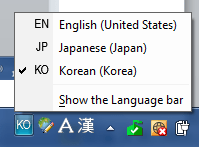
You should now have a language button on your taskbar. EN for English!

8. Want to switch between keyboards quicker? As I type in three keyboard formats, this is a nice customization. Select the tab Advanced Key Settings. Set a hot key pattern to use to switch to Korean and a pattern to switch to English.

NOTE: The default typing system will remain in English no matter what keyboard you switch to. However, if you look at your taskbar, pressing these hot keys will alter the keyboard so you can toggle between Korean and English when using the Korean keyboard. This sounds confusing but once you start using it, it will make a lot more sense.

1

Notice that though the keyboard is set to KO (Korean keyboard format), it will still type in English when you switch to it. See the A. A means that it types in English.
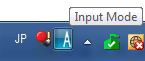
5

This occurs for any non-English keyboard. Though this is switched into Japanese, it will still type in English…
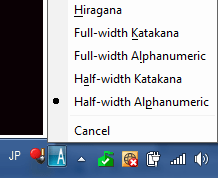
6

….until the Input Mode ‘A’ is toggled to hiragana, katakana, etc.

2

However, when you toggle the A by clicking on it, it switches immediately into hangul! See the 가? The Korean keyboard is will now type hangul!


If you have questions or need a step clarified, please comment. 감사합니다!


An extra muffin: Often, when you visit sites in other languages, your computer isn’t set to recognize characters from that language’s “keyboard” and it will show question marks or random symbols. It can’t process that HTML. When you add that language to your computer, however, it stops this from happening (most of the time).
The Little Things Count

안녕하세요! There’s one little way that I keep my Korean learning active, even when I’m too busy or lazy to do actual Talk To Me In Korean lessons, or practice writing in my wonderful big notebook, or when I’m so incredibly tired that I can’t even stay awake to exercise my Korean “ear” by watching Family Outing and trying to pick out words…

Well, I said one little way, but it actually ends up paying off big time. I have gradually put my language settings into Korean. My iPod is in Korean. My iPhone is in Korean. My Gmail account, my Twitter, my Facebook, and even my Skype are in Korean. It sounds scary – what if you try to change settings and delete something, or friend a weirdo, or Tweet gibberish and lose followers? Or, horror of horrors, you can’t figure out how to make your iPod stop repeating a song over and over?

It’s really not bad at all. If you’ve learned the basics of hangul, it actually is a huge help for reading. You’re constantly checking your phone, listening to music, or scrolling through an inbox that seems unending. A fair amount of the hangul that you’re reading is also not even strictly in “Korean.” For example, my iPod says 비디오 for video. “Bi-di-o”. On my phone, I tap the green icon labeled 메시지 (me-si-ji) to check my text messages. But because the other words are all actual Korean words, you begin to subconsciously pick up that 설정 is Setting and 음악 is Music.

I recommend that you don’t throw all your electronics and emails and whatnot into a big wad of semi-understandable Korean, though. Take your time. Put your iPod in Korean, where the worst thing you can do is choose Playlist instead of Artist because you forgot the Korean word. Once you’re comfortable with that, but not too comfortable, put your email in Korean. Your Facebook. Skype. Your phone. Suddenly, you’ll realize you’re surrounded constantly by little Korean lessons.

To be safe, if you commonly have settings that you change on your phone and you don’t want to be caught translating your entire Settings in a huge rush just to tweak something, make a note somewhere with carefully laid out steps of how to change those settings. I wanted to make sure I could check my data usage easily, so I made a note or 메모 on my phone that gave me the steps to checking it. I don’t need the note anymore, and I know all the Korean words involved in the process.

An extra muffin for you: When your email, phone, or iPod are in Korean, chances are that the annoying person who always snatches your phone to play with it or tries to prank you by hacking your email will have a much harder time. I can’t remember all the times someone has grabbed my phone and then, a moment later, handed it back in disappointment because they had no idea how to use it. But for you? Not in English? Noooot a problem. ^_^ 감사합니다!

Albert Einstein Quote

In the middle of difficulty lies opportunity.
곤경의 한 가운데에 기회가 놓여 있기 마련이다.

– 알베르트 아인슈타인, Albert Einstein

Courtesy of Hwangssabu’s Twitter. Follow him at https://twitter.com/Hwangssabu

Hwangssabu is the trainer for Big Bang. If you’ve ever at least read one of his tweets, you’ll know how incredibly energetic and excited he is for people to be healthy and fit. HWANGSSABU RULES!

A Quote A Day in English & Korean

안녕하세요!  Wonder why I use that so often? I want to get really, really fast at typing it ^_^ Anyways, I just wanted to mention something Twitter-related. I follow an account that posts a quote every single day – and the quote is given in both English and Korean. You can follow here. It’s really wonderful to read an interesting quote, often one that I’ve never heard before, and then read the proper translation into Korean, too!

Today’s quote:

Always read stuff that will make you look good if you die in the middle of it.

읽다가 죽더라도 멋져 보일만한 책을 항상 읽으라.

P. J. O’Rourke

I made the following image from a quote that was tweeted a couple days ago. The William Shakespeare quote “To thine own self be true” has always been my personal motto. I created this to help me learn the Korean translation.

Created in Photoshop 11

To Thine Own Self Be True (please credit if you remove for your own purposes)

Can’t read it? Go check out my post on how to read Korean.

Learn Korean iPhone App Review

learn korean app

안 녕하세요! Well, the world has changed. You used to have to carry around a heavy little pocket dictionary in foreign countries to help explain to a local how you have no idea where you are. These days, we have access to wonderful apps like Learn Korean on the iPhone that will even speak the words aloud FOR you. No worrying about mispronunciation.


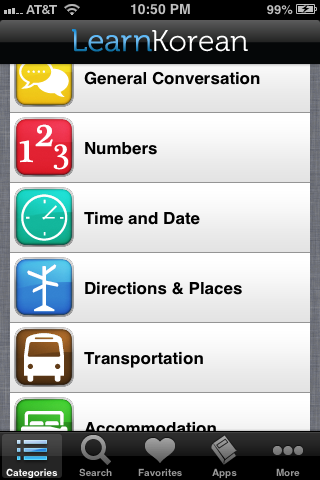
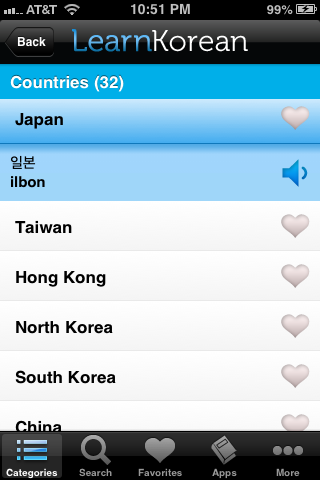
The breakdown: Learn Korean is an application in the Apple App Store. It has numerous categories: Greetings, General Conversation, Numbers, Directions & Places, Transportation, Eating Out, Time and Date, Accommodation, Shopping, Colors, Cities and Provinces, Countries, Tourist Attractions, Family, Dating, Emergency, Feeling Sick, and Tongue Twisters. The number of phrases in each category ranges 20+ and some have more than 60. Tap once, and each phrase includes the written hangul, romanization, and English translation. Tap a phrase twice and listen to a native speaker’s audio recording. Hold a finger on a phrase and copy either the hangul or the translation. Press the heart to the side of a phrase and save it as a favorite for a quick list at the bottom.


Here are some screenshots of the app in action.

Use the search option to quickly look up phrases.

Learn Korean app search

Add phrases to your favorites list for easy access.


Learn Korean app favorite phrases


Swipe through the many categories to find exactly what you’re looking for wherever you are, whatever you’re doing.


Learn Korean app categories


Tap once for the hangul and romanization, twice for the Korean pronunciation.


Learn Korean app tap


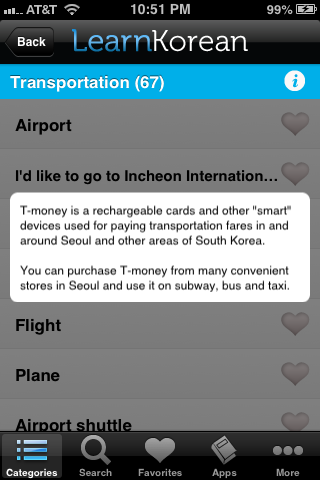
Some of the categories have little useful tips!


Learn Korean app tip


Toggle the play phrases automatically button to switch your preferences if your pronunciation is already excellent. Also, check out cogent’s other language apps. I have their full LearnJapanese app! And for first-time users, a quick glance through the Tips section is very helpful.


Learn Korean app tips


Here are some phrases from the Eating Out category.


Learn Korean app Eating Out


Overall, this is a really great app to use, whether casually or seriously. If you’re waiting in line, on a subway, AT Subway, or anywhere, you can just plug your headphones in and go over a few phrases. You can download the free version with access to Greetings, General Conversation, Numbers, Directions & Places, Transportation, and Eating Out, but to get the rest of the categories, as well as automatic updates with new phrases, you have to pay $4.99 for Learn Korean Pro. If you’re not going to rely heavily on this app, don’t bother, but if you really enjoy the free version, then just don’t buy four iTunes songs and spend your moolah on a couple hundred Korean phrases instead. And p.s., you’ll definitely enjoy access to the Tongue Twisters section.


감사합니다! 또 봐요!

Talk To Me In Korean Review

안녕하세요! This is a review of the language-learning website called Talk To Me In Korean. TTMIK uses a variety of materials, from audio to PDFs, videos to textbooks. Native Korean teachers constantly update the website with new lessons and are extremely interactive with their students, both online and in person. They’re very good teachers and they know what they’re talking about – and they’re never boring.

The break down:

  • 9 Levels, average 25+ lessons per level (exception for Level 9 which currently has only 1)
    • Explore Levels 1-7 curriculum here
    • Lesson length ranges from 1-30 minute(s)
    • Covers Hangeul, vocabulary, grammar, common phrases, verb conjugation, pronunciation, and more, for students anywhere from beginner to advanced
  • Free workbooks, quizzes, reviews
  • Everything is free or very cheap (with different pricing options)
  • iPhone Apps available for free – access all these materials on an easy-to-use App that allows you to listen while you look at the PDF on your smartphone screen
  • TTMIK teachers and materials accessible through smartphones, Twitter, YouTube, their own extensive website, Facebook, Google+
  • Created by native speakers living and working in South Korea
  • A whole lot of extra material available via TTMIK’s store and through their connected website, HaruKorean, where students pay about $6 a month for daily new lessons, 24-hour feedback, and more practice, practice, practice

Overall, Talk To Me In Korean is definitely my favorite language learning website. I would make a list of the pros, but those are already listed above because everything TTMIK does is a pro. The teachers are fun and interesting, making each lesson dynamic, and TTMIK just keeps coming up with more material in new and exciting ways! For example, if you like TTMIK on Facebook, you’ll find vocabulary pictures while scrolling through your newsfeed-they post pictures tagged in Korean to teach vocab. You’ll also hear about new materials that they create and events that they hold. You can subscribe to them on YouTube to enter contests, learn native pronunciation, and review vocab. The teachers Tweet, too. You can’t help but learn Korean from this amazing language resource!

However, I would still recommend signing up for a free Livemocha account even if you use everything that TTMIK offers and none of Livemocha’s lessons. Livemocha is an excellent supplement because it provides a platform for you to meet native Korean speakers who are learning English and chat with them in real-time. I talk more about Livemocha here, as well as explain how to utilize TTMIK.

You want to learn Korean? You can do it. Be brave. Don’t shy away. Start learning right now.

Language is the blood of the soul into which thoughts run and out of which they grow.
‒Oliver Wendell Holmes

Learning Korean: TTMIK and Livemocha are Fantastic (Baby!) Language Learning Resources

Created in Photoshop 11

(Don’t want to read my wordiness? Click here and here.)

So you’ve learned to read and write in Korean. You forget a letter now and then and you feel like a child struggling through simple sentences – but cheer up! Everybody has to read that way in the beginning. You’re about to get much better, and the way you’re going to do this is by learning Korean words, phrases, grammar, and culture.

Different people have different methods for how they learn. Some people need to see, some need to hear, some need even more interactive material. To learn Korean, you need all of the above. In this post, I’m going to introduce some of the best language resources that I’ve used to learn Korean.

1. You should head over to Talk To Me In Korean and explore. They have countless audio, PDF, and video lessons available for free, not to mention they recently (per the time of this post) came out with textbooks! I recommend that you subscribe to them on YouTube, Facebook, and Twitter. The more regular language-learning sources you have, the more you will remember even when you’re scrolling mindlessly through your news feed.

TTMIK currently has several levels of lessons, each level with about 20 or more audio lessons that range from five to twenty minutes in length. Download these lessons individually for free or in bulk for cheap and save them to your Automatically Add to iTunes folder. (Music>iTunes>iTunes Media>Automatically Add to iTunes) and then listen to them on your iPod or computer anytime. Start with Level 1 Lesson 1. Play the first audio lesson, pull out that Hangul notebook and open up the corresponding TTMIK PDF from their website. The teachers are very funny, helpful, and real – these are people who genuinely want to help you! You’ll enjoy their lessons and discover that learning Korean isn’t as hard as you thought.

In summary: TTMIK provides extensive language material (audio, PDF, textbook, video) for completely new students to linguaphiles aiming for fluency.

There’s so much to Talk To Me In Korean that I’ll discuss all their available resources in a later post. Please wait for it! ^_^

But if you use no other resource to learn Korean, then use TTMIK. They’re the best I’ve used, and while other sites provide excellent things here and there, TTMIK is the all-around winner so why bother with anything else.

2. Livemocha is a huge and growing language site for people across the globe. Sign up for a free account, choose your native language and the language(s) you want to learn, and start learning! The site first introduces phrases in Korean by associating them with pictures captioned in the target language (ie a woman waving while a voice rolls out of your speakers with a nice loud annyeonghaseyo! and 안녕하세요 appears beneath it) but it expects you to already know Hangul. Livemocha, unlike TTMIK, doesn’t provide a method of learning Hangul.

Following the phrase introduction, Livemocha users review through mini-quizzes that test their memory with written, spoken, and visual cues. An image of a woman waving appears, and the option of 안녕하세요 pops up as one of the answer options. A voice cheerily speaks hello in Korean, and the woman waves from one of the answer options. Once every question has been answered the next step is a test.

There are two tests for each lesson. The first is written. A simple prompt will be given (Introduce yourself / Write six sentences saying what something is (house, a dog, a man, a woman…) / Describe six objects.).. and then the user enters the writing submission. Likewise, each lesson provides the user with a small piece to read aloud (for Korean, it’s provided both in Hangul and in romanization). It’s necessary to have a microphone for this so that you can record your audio submissions. After completing either exercise, the user submits and awaits a review. The beauty of Livemocha is that native Korean speakers review your submissions. You’re getting real people here. Real Korean speakers who know what they’re talking about and they know it better even than the cut-and-dry Korean phrases that Livemocha just drilled into you.

In summary: Livemocha’s greatest claim to fame is that native speakers tell you what you’re doing wrong and what you’re doing right. You might even be lucky and meet a Korean speaker learning English. Exchange Skype names and start chatting! Don’t be shy. Or at least, be shy but be shy while typing in Korean. PS, you get to review the English submissions of other language speakers on Livemocha, too.

But hey. Listen up. All these resources are no good if you don’t practice. Doing a lesson each day or every few days isn’t enough. I like italicizing things. Write some Korean on the side of some notes from another class. Make a couple note cards* and flip through them between classes, while waiting in the check-out line, and not while driving. Murmur phrases at appropriate times without freaking out the poor passerby who has no idea that you are speaking Korean. Before you fall asleep, recall the new grammar and vocabulary you learned today. Because practice is that important.

Learn it, know it, use it, or lose it.

the write way to learn hangul

hangul-basic

(Don’t want to read my wordiness? Just use these links: Hangul Basics & Read, Write, and Pronounce Korean.)

WRITE IT. (And yes, my title is written incorrectly as a bad pun. Deal with it.) That’s the right way to learn Hangul, and eventually Korean. Unless you’re solely intent on learning to speak and comprehend spoken Korean, the proper first step for language-learning is studying the Korean script known in South Korea as Hangul or Hangeul (I prefer romanizing it as Hangeul although it is most commonly written as Hangul in English).

한글 Hangeul:

Han = “great”

Geul =”script”

Hangeul is a beautifully designed alphabet from the Joseon Dynasty (1443) that relies on grouping 24 vowel and consonant symbols into syllabic blocks. It’s read from left to right like English.

First, give yourself some background. The history of this script is interesting, and skimming the Wikipedia page is actually pretty valuable to provide a rudimentary understanding.

Secondly, use this fantastic free site for learning the individual symbols, their sounds, and how they fit together. It’s divided into six lessons, but currently only the first five are available. However, those five are sufficient to get you reading and writing Hangeul! The sixth lesson would teach you about double letters, but those are easy to recognize (they are simply smaller versions of the single letters!), ie ㄲ is the double letter for ㄱ.

EDIT: Also check out this post for some extra help.

It took me a couple days, spending twenty or so minutes each day, to learn Hangeul from this site. Don’t be lazy; dedicate one of your raggedy old unused notebooks to Hangeul and write out those words that the lessons give you. Include the romanization (the word written in English) as well as the pronunciation. Write the correct pronunciation the best way you will recognize it. You’ll feel intelligent, your notebook will suddenly seem much more valuable and interesting with all the Hangeul symbols covering its pages, and you’ll start impressing people with your Korean doodles.

If you don’t have much time or even if you do, do one or two lessons a day, as early in your day as you can. Throughout the day, take little pauses to write out a few of the symbols you learned. Read it aloud to yourself (quietly, so you don’t look as crazy), square your shoulders, and feel proud of what you’ve learned so far. Look at signs and visualize how they’d be written in Hangeul, and sound out all those fine phonetics. You might get it wrong at first, but practice, practice, practice – and then it’ll become second nature.

Don’t be intimidated; it’s one of the easiest alphabets to learn. 행운을 빌어요! ^_^