linguanaut – language learning survival tips

안녕하세요!

One of my favorite quick-reference sites is linguanaut. It has over 50 languages available, but I use it for Korean and Japanese. (Depending on the language you’re looking for, it has even more than just what the Korean section includes. For example, the Japanese references include a category just for famous Japanese sayings, which is pretty neat!) Its Korean section includes: Continue reading

Dongsa – Korean Verb Conjugating App Review

안녕하세요!

Dongsa

I recently discovered a fantastic app that does one thing, and that one thing very well. It conjugates Korean verbs. Dongsa, the free app that makes the features of dongsa.net more accessible to smartphone users, is exactly what you need to download (also available for Android, not just Apple) or visit right now.

Maybe conjugation isn’t a big deal to you, but conjugating can get confusing very quickly, especially when you’re just starting out as a Korean-language learner. It feels like there are way too many different politeness levels – all with their own variation on conjugation. Dongsa provides for this.

Dongsa screenshot

Type in the verb.

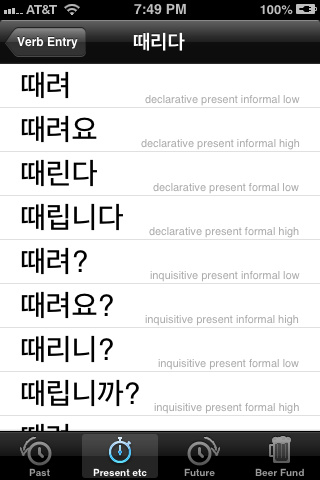
Wondering how to conjugate the verb for “to hit”? Go ahead and open Dongsa.

Notice that the app includes helpful notes for each conjugation – declarative? Inquisitive? Formal level is low? Dongsa will let you know.

Dongsa screenshot


There isn’t much to say about Dongsa other than that it’s super useful, free (you can donate to the developers’ beer fund if you feel really happy about how helpful Dongsa is), and simple to use.

These guys made this for you. Can you sacrifice an iTunes song for their cause?

Interesting concept for paying them back…


Dongsa screenshot

It comes in different tenses, how sublime!


This app is definitely a great tool to have on hand when you can’t remember how on earth you conjugate 공부하다 in the inquisitive past informal low – although that has to be one of the easiest ones to conjugate. You really do need this app, then…


감사합니다!


italki Review

italki screenshot (not mine)

안녕하세요!

Have you been looking for a way to practice your target language? Whatever the language might be (with the exception of some really far-out, ten-people-in-the-world-speak-it languages), you can probably find a native speaker on italki. italki is a site dedicated to connecting you to the people you need. Continue reading

Family Outing

Family Outing Season 1

Family Outing Season 1

(Link updated 6/23/14; please comment if links do not work! Thank you.)

안녕하세요!

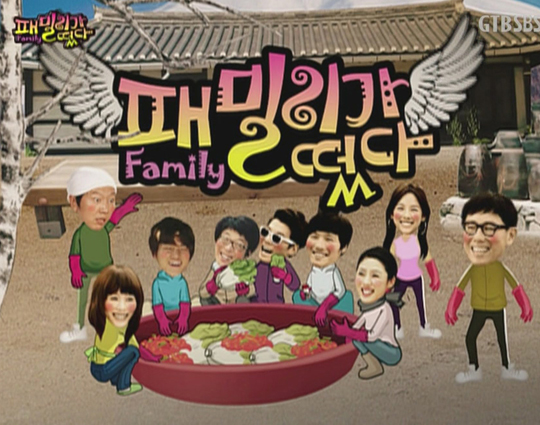
One of my favorite Korean variety shows is Family Outing (패밀리가 떴다). It’s a hilarious two-season show that aired several years ago and still provides fantastic information on life in the Korean countryside. A core group of celebrities – from singers like Kim Jong Kook, Yoon Jong Shin, BIGBANG’s Kang Daesung and Lee Hyori (a solo artist originally from Fin.K.L) to models and actors like Lee Chunhee, Kim Sooro, and Park Yejin to the “Nation’s MC” Yoo Jae Suk – along with celebrity guests go to different rural villages and small towns throughout South Korea and spend about a day and a half living in the home of an elderly couple. They take care of the couple’s chores and house while the elders are sent on a vacation.

Note: The core group changed during the show; Kim Jong Kook was unable to begin immediately, Park Ye Jin and Lee Chunhee left to pursue solo activities, and Park Haejin and Park Siyeon filled the empty spots. 

And sometimes they do things like create a "family band" and perform for villagers.

And sometimes they do things like creating a “family band” and then perform personally composed songs for the local villagers.


Family Outing is a gold mine of language-learning and culture exposure. Each episode is full of interesting activities – ever wondered how kimchi is made? Ever seen a really old machine heat up and pop rice so explosively that it make Yoo Jae Suk want to run away? Ever learned how to prepare squid after catching it yourself? Ever seen a pretty, delicate Korean actress named Park Yejin pop an eye out of a fish? (These celebrities have to get the ingredients and make the meals besides performing the chores and playing games. I’ll be honest – there was a scandal about how real their ingredients-gathering was, but that shouldn’t stop you from enjoying the show or learning Korean!) This is just a tiny peek at what you’ll see in Family Outing.

"One Man" Kim Jong Kook catches "One Fish"

“One Man” Kim Jong Kook catches “One Fish”


Family Outing wouldn't be Family Outing without lots of ridiculous and hilarious games to play.

Family Outing wouldn’t be Family Outing without lots of ridiculous and hilarious games.

Family Outing has the trademark subtitling of a Korean variety show, too, making it so rich for the language-learner. Much of what is said is also subtitled or rephrased in Korean. When a celebrity is surprised, the screen flashes a huge “SURPRISED” in Korean. When someone yells SHIMBATA – translated basically as eureka or a cry of victory – it’s subtitled in big, easy hangul. Don’t ignore these and only read the English subtitles – absorb all the Korean you can. Reading Korean subtitles will help with your language comprehension.

Chunderella choom choom chooming...clumsily.

Chunderella and Step-mother Sooro choom choom chooming…clumsily. 바보야~!


This show is funny. It’s so funny that you might want to warn others around you before you watch it, or else you’ll startle them with fits of maniacal laughter. You’ll love everyone on the show so much that by the time you finish the first season, you’ll feel like you’re saying goodbye to an actual family that you’re a part of. You’ll begin to understand the social interactions between old and young, male and female, in Korea. You’ll pick up slang, vocabulary, quick phrases. You’ll appreciate Korean culture for its tradition and its beauty. And you’ll find that watching Family Outing – while being a great learning experience – gives you that smile and that laugh that you need after a long day.


Yoo Jae Suk, the Nation's MC, endures a lot of burdensome moments for the sake of the audience's laughs...and because he's a really, really nice person in real life.

Yoo Jae Suk, the Nation’s MC, endures a lot of burdensome moments for the sake of the audience’s laughs…and because he’s a really, really nice person in real life.


감사합니다!

Understanding Hajima & Kajima

Two of my favorite words in Korean are 하지마 (hajima) and 가자마 (kajima). They are both common words in everyday 반말 (banmal) or informal language, and they appear in just about every K-pop song.

하지마 (hajima) usually is translated as “Don’t do it”. 하 (ha) comes from the verb 하다 (hada) which means “to do.” 지마 (jima) is part of a negative conjugation where the speaker asks or orders someone else to not do something.


하 (ha) = “(you) do”

+

지마 (jima) = “don’t”

= “Don’t do it”

Seungri really doesn't want you to do it. Hajima!

Seungri really doesn’t want you to do it. Hajima!


Note that the Korean word for “you” is omitted. The person you’re talking to is implied by context.

Likewise, 가지마 (kajima) uses the conjugation of 지마 (jima). 가 (ka) comes from 가다 (kada) which is the verb meaning “to go.”


가 (ka) = “(you) go”

+

지마 (jima) = “don’t”

= “Don’t go.”

Please, GD, kajima!

Please, GD, kajima!


These phrases are commonly used in dramas where someone orders someone else not to do something or to go somewhere.


Person 1: 집에 가. (Jib-e ka.) “I’m going home.”

Person 2: 집에 가지마! (Jib-e kajima!) “Don’t go home!”

From http://25.media.tumblr.com/b0b55f4def1776af83390768a9c86fc2/tumblr_mgahm3FZMj1rwnim2o1_500.gif


Person 1: 그래. (Keurae.) “Okay.”


top jibe


That just about sums up GD & T.O.P.’s ‘Don’t Go Home’ song. Can you guess the Korean name of that song? 네. (Ne.) It’s 집에 가지마 (jib-e kajima).

Here’s an example using “Don’t do it.”


Person 1: 야…난…널… (Ya…Nan…Neol…) “Hey…I…to you…”

Person 2: 뭐? 야! 하지마! 하지마! (Mweo? YA! Hajima! Hajima!) “What? HEY! Don’t do (say) it! Don’t!”

Person 1: 사랑해. (Saranghae.) “I love you.”

T.O.P. loves SE7EN-hyung

T.O.P. loves SE7EN-hyung

Person 2: 하지마! 난 니가 싫어.. 넌 못생겼어.  (Hajima! Nan niga sirheo. Neon mot saengyeosseo.) “Don’t! I hate you. You’re ugly.”


T.O.P. disapproves


How about some song examples in K-pop where hajima or kajima are used very obviously?

Monster by Big Bang

Don’t Go Home/Jibe Kajima by GD & T.O.P.,

Stop It by B.A.P.

감사합니다!


A/N: Revised April 9, 2018, as the previous version was written years ago when I barely knew any Korean; I previously (and mistakenly) told readers that these sentences can also mean “I don’t do it”. That was incorrect. 하지마 and 가지마 are both commands/requests to another person to not do something. An exception may occur in the form of a question in some situations, such as when someone teases someone else. The would-be teaser might ask, “하지마?” Effectively, they’re saying to the other person, “(Are you telling me) don’t do it?”

Happy studying!

Stroke Order: Hangul’s tribute to Chinese Calligraphy

'Stroke' text created in Photoshop 11

안녕하세요~!

Just like Chinese characters have a specific order to their lines, hangul letters also have proper stroke order. While no one’s going to give you a dakbam (probably) if you draw the bottom line before the top, it’s a good idea to learn stroke order. If you’re going to learn how to do something, why not learn how to do it correctly?

Although at first it’ll be difficult to remember the proper order, and writing with stroke order will slow you down, it’s worth it. Once you get the hang of it, those hangul letters will all but fly off the tip of your pen. It just takes a little practice.

Check out this site which provides images of each step to drawing the correct order for each hangul letter. This other site includes playable clips of writing in hangul with correct stroke order.

감사합니다!

Reference Links:

http://www.speakoutkorean.com/learn-to-write-korean-stroke-order-consonants/

http://www.sayjack.com/blog/2010/12/17/stroke-order-of-korean-hangul/

Who is Pororo?

Pororo and Friends courtesy of http://ayiekpunya.wordpress.com/pororo-wallpaper/

안녕하세요!

If you’re interested in Korean culture – and I mean modern culture – or you watch dramas or variety shows, you’ve probably heard of Pororo. Pororo is a famous little blue penguin who is the protagonist of his own show – Pororo the Little Penguin.

While you might dismiss Pororo as an uninteresting children-oriented character, think again. Pororo is famous in South Korea; he is one of the most-watched kids’ shows, and just about everybody knows what you’re talking about when you reference him. From a language-learner’s perspective, Pororo is gold.

dancing Pororo GIF from Viki

He’s a happy dancer, too.

Many non-native English speakers who come to the U.S. watch Sesame Street and learn the fundamentals, or supplement what they already know. Pororo is similar to Sesame Street in that sense. It’s broadcasted on EBS in South Korea and each episode is about 5 minutes long. 5 minutes. And you can watch its 73 episodes on Viki for free, subtitled in English and Spanish, and sometimes even in Turkish and other languages. (Viki also has an app, so you can watch shows on the go!)

No matter what age you are, kids’ shows can be enjoyable. They’re a nice, stress-free break from the rest of reality. But as a language-learner, no offense but your comprehension skills aren’t what they are for your age in English unless you’re perfectly fluent. They’re probably notched down quite a bit – perhaps more to a pre-schooler or middle-schooler. Pororo the Little Penguin is the perfect fit.

Not only will Pororo help you learn Korean, but it will also provide a conversation point when you go to South Korea. “Oh, you watch Pororo?!” Of course, not every person you meet will want to discuss the plot of episode 34, but it’s a starting point, and maybe it’ll make your conversation partner think, “Wow, this person is serious about learning my language.” And it’s always nice to make a good impression.

Pororo and friends courtesy of http://themepack-gratis.blogspot.com/2011/10/pororo-little-penguin-wallpapers.html

감사합니다!

Write BIGBANG’s name in Korean

how to write BIGBANG

빅뱅
BIGBANG
Photo from BIGBANG’s Alive Tour in New Jersey, taken by site’s author.
Edited in Photoshop 11.

Korean Greetings & Farewells

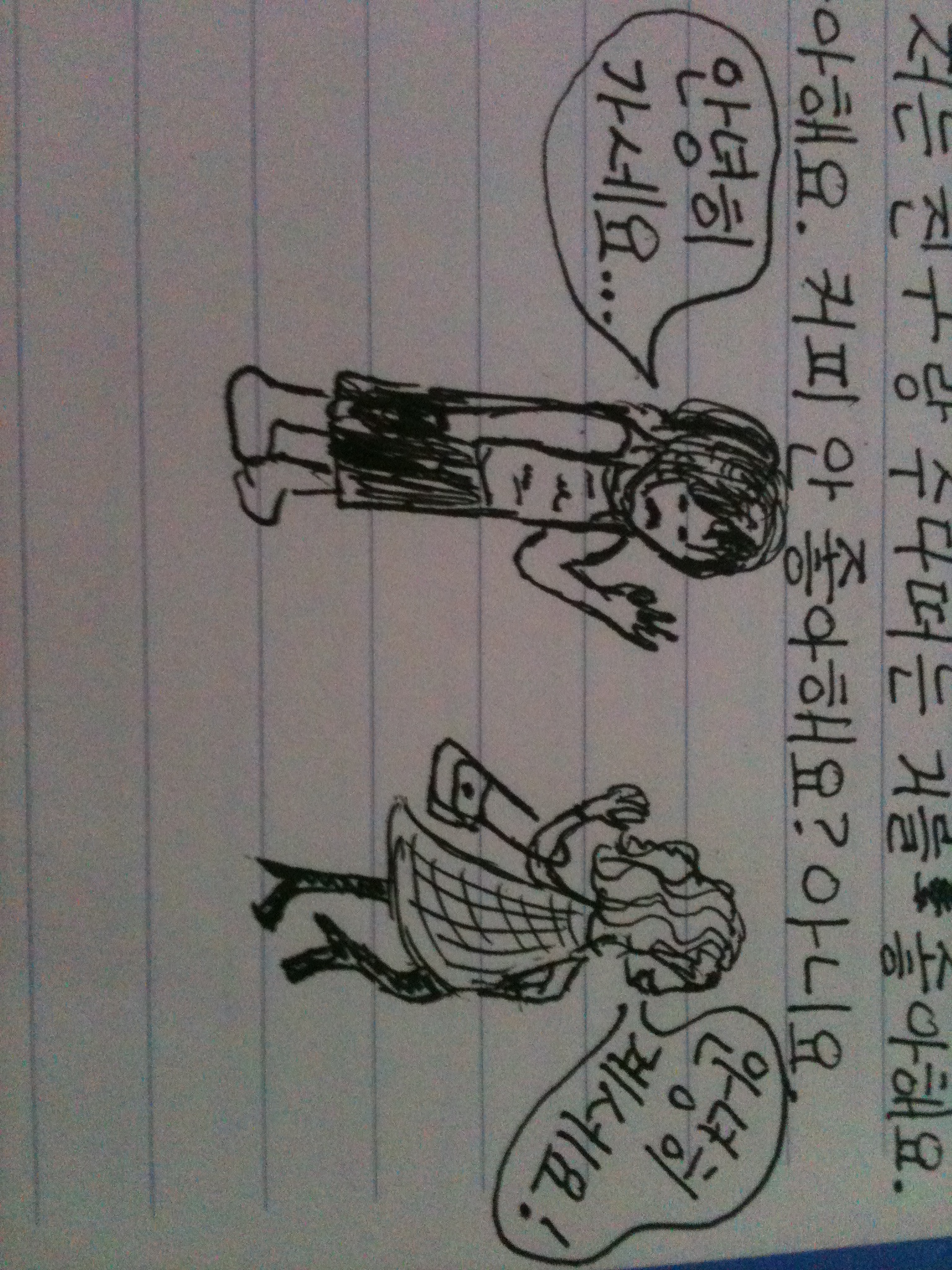
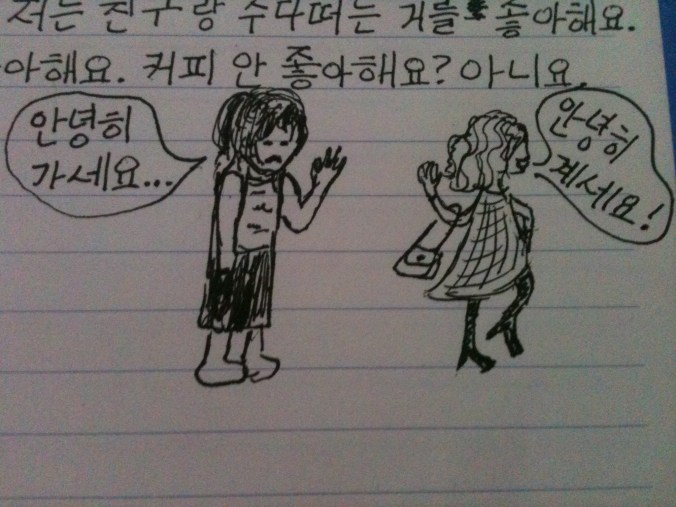
I have the best drawing skills, you know.

Goodbye vs. Goodbye in Korean

안녕하세요!

Greetings and farewells in Korean are quite interesting thanks to the common root of “annyeong” or 안녕. Because 안녕 literally means peace, when it combines with -haseyo, it means “Are you at peace?” While informal greetings and goodbyes usually consist of quick “안녕~”s without -haseyo’s and -hi-gaseyo’s and -hi-gyeseyo’s, it’s a must to learn the difference between them.


안녕 + 하세요 = peace + you do/please do


안녕하세요 (annyeonghaseyo) is usually translated as “Hello”  or just “Hi” but it is informal and 안녕 alone might be more suited for meaning an informal “Hi”. And if you’ve watched any k-dramas or know anything about Korean culture, you’ll know that bows often accompany greetings. Bow and say annyeonghaseyo! It’s all about respect. Be respectful and you’ll be respected.


안녕 + 히 가세요 = peace + you go


안녕히 가세요 (annyeonghi-gaseyo) is what you say when you are staying and the other person is leaving. In Korean, the verb for “to go” is 다 (kada). Thus, “go” is 가 (ka). Look at this goodbye again: 아녕히 세요. Can you guess what it means? Go in peace. Annyeong-hi-gaseyo.


안녕 + 히 계세요 = peace + you stay


안녕히 계세요 (annyeonghi-gyeseyo) is what you say when you are leaving and the other person is staying. What does it mean? Stay in peace.


알았어요? Just remember. Ka/ga for go. Annyeonghi-GAseyo. 안녕히 가세요. But do you remember “hello”? What are the two formal farewells? Let’s use a story to put things into perspective.


안녕세요. Annyeonghaseyo – because you were walking through a huge grocery store looking determinedly for brussel sprouts so that you could burn them to release stress, and when you found them you shouted, “HA! 안녕세요. AnnyeongHAseyo, you little sprouts!” Then you saw me running in the opposite direction because I was unnerved by the weird actions of a person speaking Korean to vegetables. What did you say to me? 안녕히 세요! “Annyeonghi-GAseyo!” You said, because I was going (ka/ga = go) and you were staying. “안녕히 세요! Annyeonghi-GYEseyo!” I shouted back to you over my shoulder, hoping desperately that you would STAY and not follow me home to burn brussel sprouts in my front yard.


Please check out Talk To Me In Korean’s lessons on the 3 annyeong’s:

Level 1 Lesson 1: Hello & Thank-you

Level 1 Lesson 3: Goodbye, See you

And for a bit more learning, look at Greetings in Korean, courtesy of Rocket Languages.


Note: Informal Korean doesn’t necessarily use 안녕 all the time for greetings and farewells. While an always safe and natural fallback, 안녕 is just the tip of the ice berg. Do you always tell your friends “Bye” when you’re leaving and “Hello” when you’re arriving? No. You say things like “What’s up”, “Catcha later,” “Hey,” “See ya,” “Hallooooo~” and any other variation. Once you get the 3 annyeong’s down, learn some other ways of greeting and goodbye-ing – it’ll be great for your vocabulary and make you sound more natural when speaking informally with friends.

감사합니다!

Starting Smart & Small: Reading in Korean

안녕하세요!

I recently discovered a wonderful and unexpected resource – the library. While yes, the avid language learner can go search out grammar guides and Korean-English dictionaries, and maybe find a set of old CDs that teach tourist-level phrases, there’s something much, much better hiding in your library.

Children’s books.

That’s right. Cute picture books with simple sentences, simple grammar, simple vocabulary. While there are also lots of chapter books available in non-English languages, children’s books are 대박. Grab those first, and don’t even think about eyeing those bigger books even though you really want to feel accomplished with your level of Korean.

Why? 왜요?

Think about how you naturally learn a language as a child. You learned your native tongue from adults speaking it around you constantly. You might have watched TV shows that solidified what you heard from adults, as well as introduced you to a larger world than your house, backyard, and preschool. But one of the other ways you learned was by reading with an adult. Children who read a lot from a young age tend to have more natural writing skills. If you want to learn to write well in Korean, start small, and start with reading. Even if you think your Korean is relatively advanced, don’t just head straight for the chapter books. If they’re too hard, they might discourage you and you’ll feel frustrated. Don’t give up!

Children’s books still provide a fair challenge – and as a bonus, depending on the book, they introduce you to stories that native Koreans grew up with and still remember fondly. I discovered that my Korean friend and I read the same book as children – yet she read in Korean and I, English. She had me read the Korean book aloud to her and translate it. While I still struggled with some meanings, it was encouraging and I finished the book with a stronger understanding of general sentence structure and a few words added to my vocabulary. Not to mention, I fixed some pronunciation with my friend’s help!

The next time you’re wandering through shelves looking for a good read, head for the foreign titles section, browse through the Korean selection, and choose the easiest-looking picture book you can find. To make more enjoyable, choose one that you read in English as a child – it’ll be more meaningful and since you’ll remember the general story, understanding the Korean will come easily.

Start smart. Start small. And soon you’ll be reading in Korean like, well, a five-year old.

But still, a five-year old Korean reads much better than an English-speaker who can’t even tell which Asian language is written on the cover of a kid’s picture book. Think of it as your first step, your first book as a child that you tried to read by yourself; if you pursue it and practice, your Korean will “grow up” into those big chapter books and open a whole new world. Just like your first language did.