Doing what scares me

“Do one thing every day that scares you.”

여러분 메리 크리스마스!

Back in the summer, I decided that rather than waiting until I had a ‘firm grasp on Korean’ – whatever that means – I was going to start writing short stories and not let my ignorance of vocabulary and grammar or my fear of imperfection stop me. I bought a cute little notebook that fit into my pocket and tried to write at least one little story each day.


My cousin and I went to G-Dragon’s Peaceminusone exhibit the first week that I was back in Korea and that evening, as we sat on the second floor of a cafe near Yonsei University, we decided to create. She’s an amazing artist; I have a passion for writing. Inspired by the creativity we saw at the exhibit, we decided we wanted to not just consume but produce. I wrote, she sketched.

I got to around thirty this past summer. Thirty very short, very simple, flaw-filled stories. Most of them reached perhaps a single tiny page, and a few were scribbled across more than one page. I tried to write with varied characters and plots, and found that it was quite the challenge.

It can be hard enough to write a good story when you have time and space and fluency to wax eloquently, but when you’re confined, you have to be far more creative.

I loved it. I love my little foolish tales, for all their mistakes and awkwardness. Per the suggestion of one of my Korean friends, I made an Instagram account called Green Tea Girl in Korean to post them to, but I all but forgot about it until recently. I’ll start posting them there again, but I’m also going to share them here.


Do you see glaring errors? Little mistakes? Please do let me know. I may never do anything with them besides share them with my readers, but isn’t that all that matters – sharing what I’ve created, however small, with others. I hope you enjoy them, and I hope you feel inspired to do your own creative works.

In my mind, creating is the best way to resolve problems of the heart and mind, because you can take what constitutes the problem and reshape it into something that allows you to confront – or at least acknowledge – the problem itself.

감사합니다, and I hope you enjoy my little stories. I’ll link to them here once I begin posting them.


P.S. The formatting was lost in the Instagram post, but here’s the story titled 훌륭한 형님:

“야, 이놈아 진짜-“
어둡고 늦은 밤에 남자들 4명이 한강의 강둑에 서 있었다. 그들의 발 밑에 의식을 잃은 남자가 누워 있었다.
“이제 이 자식 숨을 쉬지, 뭐….형님, 너무 화가나지마세요.”
“내가 이 자식 몇 번 말했는데도!”
“형님…” 갑자기 강둑에 누워 있는 남자가 정신을 들었다. 그 형이 즉시 무릎을 꿇었다.
“무슨 일이야, 이 자식아. 어디 다친 거 없어? 이 형 얼마나 걱정됐는데…”
“형님…”
“머-머-뭐?! 내가 뭐?”
“형님 보고 싶었어요.”
“이 놈아.” 그 형은 다른 남자에게 시켰다.
“빨리 차 데리고 와!”
“형님…”
“왜.”
“제가…죽을 것 같아요?”
울음을 참으면서 그 형이 대답했다. “아니. 형이 죽을 때까지 네가 죽지 못해! 알았어?”
“예, 형님…”
“이 자식아.”

지금 재생중

Watching Wootso – Funny Korean Videos

안녕하세요!

Lately I’ve been looking for pages to follow that share Korean-related videos, and my favorite is currently Wootso/Goteng. Wootso is on Facebook and Goteng is the YouTube account, but they’re created by the same people. They posted far more on YouTube, but their Facebook shares short, funny clips that are great for procrastinating AND getting a bit of Korean listening practice in.

Some of my personal favorites include Zion.T going to the store…


….that subway strug-life….


….complaining about the way people use social media for birthdays…


…and definitely this video on the differences between having a conversation with a girl vs. having a conversation with a guy.


Even though Wootso joined Facebook only this year, they seem to be getting quite a substantial following. Go ahead and check them out, and procrastinate on!

감사합니다!

Bonus Fav:

Translating Korean Poetry

Despite the fact that I haven’t posted anything new in a few centuries, I have been actively studying Korean. Coming back from Korea was a whirlwind of adjustment and academic rigor and it took all of my focus to keep up.

Actually about me in the morning. During post-Korea life, my sleep deprivation has vastly increased. 

Well, not all of it. I’ve started translating Korean poetry wpid-20150101_150924.jpgas a self-study method. My current focus is on an anthology of Koreans’ 100 Most Beloved Poems, or 한국인이 가장 좋아하는 명시 100선. A very good friend of mine gifted it to me just before I left Korea.  Continue reading

Books I bought in Korean (and other acts of madness)

wpid-20150101_150819.jpg

새해 복 많이 받으세요!

It’s already been over a week since I left the Land of the Morning Calm and returned home – and discovered that Seoul has more snow than Michigan, which is terrible. Michigan, I feel betrayed!

In my three heavy suitcases, I lugged back my earthly possessions: clothes, gifts, selfie sticks, and of course, books. Textbooks, biographies, and works by Andrei Lankov, obviously, but more pertinent to my language studies, I brought back books in Korean.

Me in the Kyobo Bookstore inside Gwanghwamun Station

I am a firm believer that the more you read, the wiser you can become, and the better you learn to write and comprehend. It doesn’t matter what language you read in; it will help you. Korean is no exception, which is why I pushed myself to buy two novels that I know I cannot read without laboring over each paragraph. You can’t get better without challenging yourself. I also chose to buy poetry, because poetry is artistic and allows one to learn about the creative soul within a language.  Continue reading

How To Obtain A D-2 Student Visa For South Korea

So, you’ve been accepted to that awesome study abroad program. You’re looking at plane tickets (nothing new, probably) that you might actually buy (that’s very new, actually). You’re googling the best places to visit in Seoul, the best way to travel to Busan, the top tasty spots in Myeongdong. You’re reviewing your vocab lists. You’re wondering if you can work in a trip to Jeju Island during Chuseok. What’s happening? You’re going to Korea!

But first, you have to apply for a visa. And the process is a maddening, confusing, difficult process.

But it’s a necessary evil. That’s why I’m going to explain how I did it, what went wrong, and how I survived the process.

Continue reading

Manhwa Mania (sort of)

안녕하세요!

This summer has been full of preparations (mixed with far too much stress and madness) to go to Korea and almost no true, consistent studying of Korean. The one reassurance that my Korean abilities haven’t completely fled comes from my nightly manhwa time.

만화 (manhwa) – a glorious method of reading delightful comics for fun under the thin disguise of “studying Korean”.

When I began reading manhwa, I only really read Penguin Loves Mev because even that simple and sweet story was difficult for me to read in Korean. Each short sentence had a cute, comical illustration that helped me figure out the meanings of words I didn’t know – but I struggled through one chapter at a time, and I translated infrequently but with great effort, dissecting the grammar and asking my language partners about the usage of some words.

Sometime last fall, I got a new phone and discovered that Naver Webtoons has an app (I’d always read Penguin Loves Mev on my laptop). While I was exploring how to use the app, I became interested in trying other manhwa. As much as I loved Penguin Loves Mev, I wanted to challenge myself more (and I generally like fiction/fantasy/adventure). I bookmarked a few new manhwa to try and quickly became fascinated with 천년구미호 (1000 Year Gumiho).

There are lots of reason to read this manhwa. I absolutely love mythical creatures and legends, so anything about a nine-tailed fox (gumiho) from Korean myth – there are related legends in other Asian countries – is sure to grab my attention. I could also extol the virtues of the illustrations and plot….but this post is about language learning.

Time to put my study face on. And study James McAvoy’s beautiful face.


The other reason I love this manhwa is because of the language itself. It’s set in modern-day Korea, so there’s slang and modern colloquial conversations, but since it incorporates lots of ancient mythical creatures, these characters converse in old, historical Korean: very formal and often very different from what you’d hear a friend say to you. It’s an awesome mixture of old and modern Korean and I learn new things in every single chapter.

One of the best things about this manhwa is that the story is so interesting that I never can read just one chapter at a time. I often read at least five, even if it takes a long time, but this is a huge improvement from me struggling through one chapter a night (if that). I’m motivated to continue reading and practicing Korean because I want to know what happens next.

Don’t misunderstand; I definitely don’t understand everything in each chapter, but I’ve vastly improved since last fall when I began reading manhwa again. I can tell that my speed and comprehension has picked up enormously, and the more consistently I read, the better I am at Korean in general.

And, you know, it’s just so funny sometimes. The chicken is probably my all-time favorite character.

cheonnyeon

Yes that wondrously evil-looking face is the face of doom. A chicken. Technically a rooster. Ah, well.

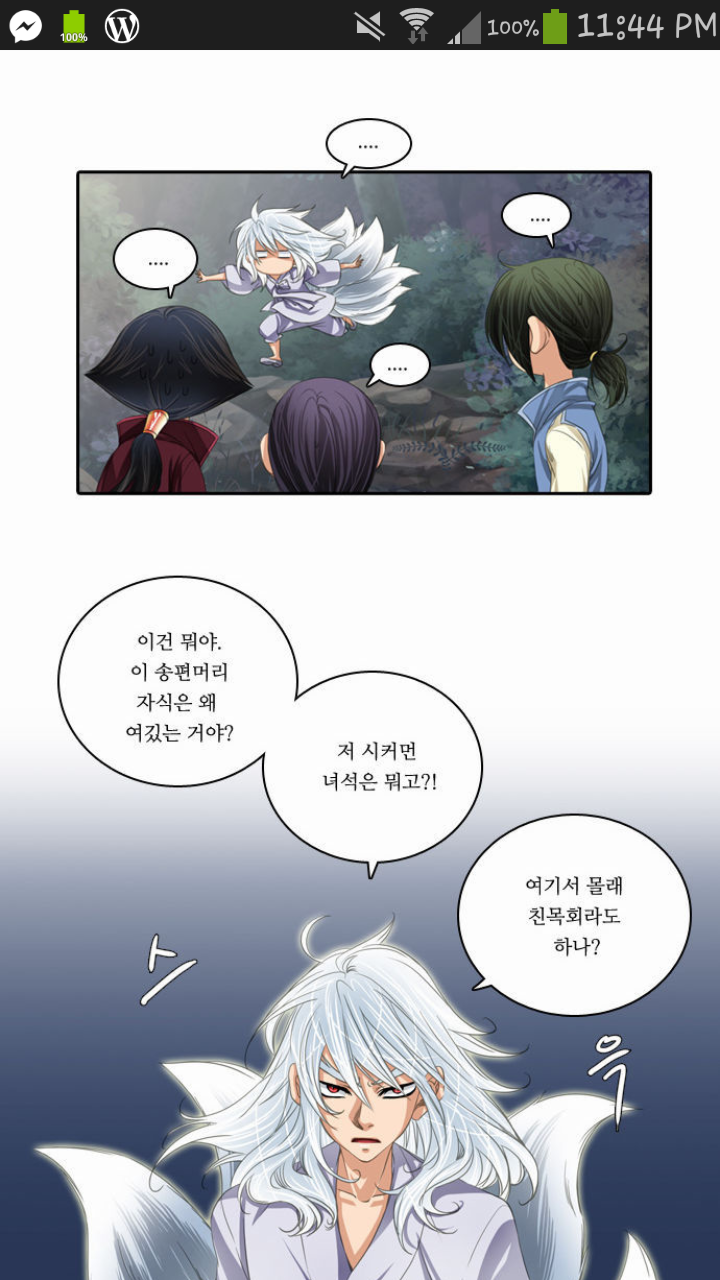
There are beautiful moments of comedy that make me burst out laughing, scenes of angst and romance, and entire chapters full of action and danger. And then there are scenes where someone FINALLY MENTIONS that one of the evil guys has a hairstyle that makes his head look like a 송편 (songpyeon) which is a traditional Korean food. Check out the head of the guy on the left and compare it to the picture of songpyeon.

cheonnyeon 2

Do you read any manhwa? Let me know if you have a favorite or if you’ve also enjoyed reading 천년구미호. Woohoo for reading!

And 감사합니다 for reading this^^


지금 재생 중 (because 괜찮아, 사랑이야 (It’s Okay, That’s Love) is a fantaaaaaaastic new Kdrama that finally confronts the stigma about mental illness as not being worth the same care as physical illness. Also because this song is really pretty):

Pay tribute to me! Mistakes in Korean

안녕하세요!

It’s been a while since I’ve updated my Miss Interpretation section. Not because I’m not making mistakes, but mainly because they’ve been relatively boring mistakes. I haven’t said anything really inappropriate or completely grammatically incorrect in a while, but I’ve continued to make little mistakes without advancing much. Sigh. I need to get down to business to defeat the Huns and actually get back into intense studying.

Actual photo of me. I’m secretly a muscular Chinese man, but don’t tell anyone.

I did, however, have any interesting conversation with one of my language partners on Skype Continue reading

나는 학생이다: Turning Laziness into Education

안녕하세요!

I’ve been spending a lot of time watching endless clips of 나는 가수다 (Naneun Kasu-da. trans: “I am a Singer”) and Immortal Song 2 on YouTube. They are music shows that feature singers who perform their own renditions of Korean oldies and I think they’re absolutely phenomenal. I’m a music lover to my very core and these old songs and these incredible singers affect me so deeply.

But let’s be honest. Watching YouTube clips for hours at a time isn’t quite conducive to attaining Korean fluency – unless I incorporate a studious attitude!

The greatest boon of Korean broadcasting to language learners like myself is its penchant for Continue reading

Korean in College: is it worth it?

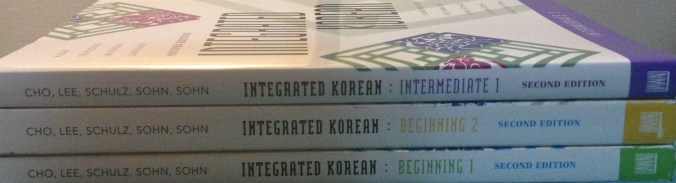
korean textbooks

안녕하세요!

As an independent language-learner, I was both apprehensive and excited to be able to take a Korean language class once I entered university last August (2013). Although I took Spanish for over 10 years previously, I had no idea how my abilities in Korean compared with students who took language courses. I had never taken any test, and although Koreans who I spoke with always lauded my Korean, I felt like it was somewhat empty praise. Don’t misunderstand – I’m happy that people are happy that I study Korean; I just wish they didn’t hand down praise so easily when I say just a word or two.

I spoke with my Korean professor who told me not to take the placement test. I was already in the first level along with beginners in the language, most of whom did not yet know hangul. I realized a few weeks later that I really should have taken the exam anyways; I probably could have landed in second year very easily. However, I recognized that my speaking abilities were basically nil, and that I could focus on that and vocab as my goals for improvement.

I don’t blame my professor, either. I know that several other students approached her and said the exact same thing as me – “Oh, I’ve studied some Korean before.” Most of them meant – “I can kind of read hangul.” She found out later, and through my participation in her class, that I had studied for almost 2 years before coming there.

The main problem I found with taking first level rather than passing into second was mainly how slowly it went for me. First semester was so incredibly basic that I only really felt like I improved in counting and speaking slightly more confidently and fluently. There was nothing else new, and I knew almost all of the vocabulary.

Second semester went better, but I had yet to learn a grammar structure that I didn’t already know. Vocabulary started to be half and half with words I knew and words I didn’t know yet. Overall, we covered only 2-3 grammar points that I had never heard before or studied. I definitely improved with speaking, but my progress in everything else remained stagnant.

Looking back over the past academic year, I realize that I made two essential mistakes.

1. If you have studied Korean before, even just a little, I highly recommend testing to ascertain your level before you commit to a class. It may be more challenging to take a higher level class, but overall, isn’t your goal to challenge yourself by becoming fluent in a language?

2. Do not stop or lessen your independent studies. This was definitely my bigger problem. I was used to rapidly advancing through TTMIK lessons and making leaps and bounds with my comprehension of spoken and written Korean, but I spent almost a year of barely studying on my own. I also didn’t study much at all for my actual Korean class because I did so well in it without needing to. It made me lazy with my language studies, and I deeply regret that.

In conclusion, I have decided to never stop my independent studies. It doesn’t matter if I’m taking Korean at my university or even living in Korea and studying there. It’s pure laziness and nonsense to stop studying. I’m not going to magically become fluent by decreasing my studies. Independent studies coupled with other language learning experiences is like adding extra engines to a jet; you’re going to get there even faster if you combine rather than minimize.

Also, I’m not advising you to not take a Korean language course – I’m just advocating that you also continue your independent studies and take a placement test.

Have you ever taken a Korean language class or do you only do independent studies? Or do you combine them? Let me know in the comments about your experience! I’m also curious what it’s like to take placement tests…and TOPIK….

감사합니다!


Here’s some lovely music for a lovely day!

Summer Goals

Summer’s almost here. My last final is tomorrow and yet I’m most overjoyed over the prospect of never seeing or hearing from my roommate or her boyfriend again. I’m going to truly miss the vivacity of campus life as the town empties of most of its students, but at least I know some of my friends will be here for a month or two longer. 가지마~~~ ㅠㅠ

Please, GD, kajima!

I can’t fairly complain about people leaving me though, since I’m planning on spending the fall 2014 semester in Seoul. Yes, Seoul. Is it possible to miss a place you’ve never been? I think so. In the meantime, however, I need to get ready. And by getting ready I mean I need to immerse myself as completely in the Korean language as I possibly can over the next several months, because my goal is to return for the winter 2015 semester and test directly into the second semester class of 3rd year Korean. I’ve never been formally tested to see what my level of fluency or ignorance is, and so I’ve been taking 1st year Korean during my freshman year – a seriously entertaining choice because my comprehension of grammar points reaches into much of 3rd year Korean….yet my speaking abilities were basically nil when I entered the class in the last dog days of August almost eight months ago. Or nine. I’m not sure; math isn’t my strong-point and I definitely just counted the months on my fingers and still am not sure if it’s 8 or 9.

I’ll soon be writing up some posts about my experiences taking Korean this past year (this is a promise because otherwise I’ll conveniently forget to do it while reveling in summer sunshine, bubble tea, and the hopes that Big Bang might actually make a comeback within the next decade),but in the meantime I’d like to discuss some of my language-learning goals.


1. Complete review of all Talk To Me In Korean levels up until my current one. And of course, resume actively studying new lessons and leveling up. LEVEL UP. Oh wow, I feel my gaming days returning already….Ahem, and in doing these reviews, I’m going to focus on speaking practice – my biggest nemesis in language learning. Because who really wants to hear herself mispronounce things repeatedly?

2. Establish vocabulary studying regimen (alongside my best friend/language study buddy) of exchanging lists of at least 20 words each every week and then practicing with all 40 via italki posts and my own journaling.

3. Reach a fluency level enabling me to write short stories in Korean! This is a big one for me, since one of my biggest passions since kindergarten has been writing stories. I used to write intense murder mysteries about three detective fairies while I was in kindergarten. Yeah, you’re jealous.

4. Work my way through one Korean novel per month. Now that‘s slightly insane and also mostly possible. I’ve had a book from the library that I’ve been renewing for about 10 months now and I understand the entire first page easily. I just get a bit tired by the second page…but that’s just laziness. This is summer! And summer means….study….time. Actually, summer means finally reading the books I wanted to read all school year long but couldn’t because I had twenty-some novels for my classes to plough through first.

5. Confidence in Korean. This is a big one for me. I’m all fluent and wordy when I’m practicing alone or making small talk with two of my fellow Korean-learning friends, but when confronted with the sweet ahjumma at Arirang who is asking what I want to eat, or when greeting my Korean friend’s wonderful aunt who makes jokes in Korean to me, I freeze up and retreat into the fortress of my native language. This goal isn’t really something I can specifically practice for, other than by practicing and practicing and letting go of the safety-rail of English. Mistakes are okay. They really, really are. And I usually tout this belief quite strongly until my face is burning red from mispronouncing something or randomly swapping the ending to the verb from past tense to future because I’m so completely caught up in being grammatically correct that I forget what the meaning of my sentence was in the first place. So, confidence. Confidence in Korean.


Do you have language learning goals for the summer? 화이팅!!! 그리고 감사합니다!