When you have faults, do not fear to abandon them.
-Confucius
허물이 있다면, 버리기를 두려워말라.
-공자
Translation courtesy of Hwangssabu-nim.
When you have faults, do not fear to abandon them.
-Confucius
허물이 있다면, 버리기를 두려워말라.
-공자
Translation courtesy of Hwangssabu-nim.
안녕하세요!
I recently discovered a wonderful and unexpected resource – the library. While yes, the avid language learner can go search out grammar guides and Korean-English dictionaries, and maybe find a set of old CDs that teach tourist-level phrases, there’s something much, much better hiding in your library.
Children’s books.
That’s right. Cute picture books with simple sentences, simple grammar, simple vocabulary. While there are also lots of chapter books available in non-English languages, children’s books are 대박. Grab those first, and don’t even think about eyeing those bigger books even though you really want to feel accomplished with your level of Korean.
Why? 왜요?
Think about how you naturally learn a language as a child. You learned your native tongue from adults speaking it around you constantly. You might have watched TV shows that solidified what you heard from adults, as well as introduced you to a larger world than your house, backyard, and preschool. But one of the other ways you learned was by reading with an adult. Children who read a lot from a young age tend to have more natural writing skills. If you want to learn to write well in Korean, start small, and start with reading. Even if you think your Korean is relatively advanced, don’t just head straight for the chapter books. If they’re too hard, they might discourage you and you’ll feel frustrated. Don’t give up!
Children’s books still provide a fair challenge – and as a bonus, depending on the book, they introduce you to stories that native Koreans grew up with and still remember fondly. I discovered that my Korean friend and I read the same book as children – yet she read in Korean and I, English. She had me read the Korean book aloud to her and translate it. While I still struggled with some meanings, it was encouraging and I finished the book with a stronger understanding of general sentence structure and a few words added to my vocabulary. Not to mention, I fixed some pronunciation with my friend’s help!
The next time you’re wandering through shelves looking for a good read, head for the foreign titles section, browse through the Korean selection, and choose the easiest-looking picture book you can find. To make more enjoyable, choose one that you read in English as a child – it’ll be more meaningful and since you’ll remember the general story, understanding the Korean will come easily.
Start smart. Start small. And soon you’ll be reading in Korean like, well, a five-year old.
But still, a five-year old Korean reads much better than an English-speaker who can’t even tell which Asian language is written on the cover of a kid’s picture book. Think of it as your first step, your first book as a child that you tried to read by yourself; if you pursue it and practice, your Korean will “grow up” into those big chapter books and open a whole new world. Just like your first language did.
안녕하세요!
I can say without a doubt that Talk To Me In Korean is my favorite Korean study resource. It has constant updates to add to its existing lessons and it uses really fun and informative videos, audio, PDFs, physical textbooks, pictures, and more (ie social media like Twitter and Facebook) to teach Korean. Since I love TTMIK, I was excited to try their Slang Expressions in Korean lessons (they’re available online at My Korean Store). This great product allows the purchaser to choose which price to pay based on their funds or what they personally think the product is worth and is inexpensively priced at $2.99, $4.99 or $9.99.
The Slang Expressions lessons are well worth any price. The package comes as an online download; after purchasing, I waited a few minutes for a confirmation email and then an email with a link to a temporary download. The lesson package can be downloaded a couple times (if you have multiple computers, you can download it to each one rather than spending time transferring with a USB), and the download link expires after about a week (so if you decide to get this, don’t sit around for a month not checking your email and wondering where on earth your Korean slang lessons have gone).
The Slang Expressions download came as a zipped folder that unzipped to show four audio files (I copied them to iTunes and added them to my ‘TTMIK Extras’ playlist) and a PDF (if you have an iPhone, download the iBooks app for free, add the PDF to your iTunes books library by dragging it or copying it, then sync that PDF to your phone to study Korean on the go). The four audio files included three lessons – Chapters 1, 2, and 3 – and a great Mini Dialogue Audio Track to practice with at the end of the lessons.

The audio
The PDF
 Overall…
One big reason why I love TTMIK is that their lessons, while being extremely relevant, helpful, and informative, are never boring, and just about every sample dialogue is funny (I often find myself laughing while I’m studying). Each useful phrase is either a common real-life example or a conversation that sounds like it’s straight out of a funny and romantic Korean drama. These Slang Expressions in Korean lessons include some of my favorite funny dialogues.

Beyond being funny and memorable, the phrases are surprisingly relevant. I hesitated to buy this at first because the phrases that the product description mentioned seemed irrelevant to most regular conversations – yet the lessons’ examples showed me that these phrases are a great asset to my vocabulary; I can’t wait to begin using them naturally in conversations and understanding their use in music, shows, and real life.
I definitely recommend that you check out the sample audio and PDF and then purchase these lessons to add to your Korean study resources. If your Korean isn’t high enough to understand complex grammar and all the ins and outs of how a sentence is put together, don’t worry; these lessons are very simple and easy to follow, and you can always begin by memorizing terms. Save the sentence dissection for when you get to that level. Speaking a language is all about sounding natural, and these Slang Expressions can set you on the right path.
NOTE: The majority of the Slang Expressions lessons are in informal language or 반말, which means just because you’re feeling high and mighty and like a G-Dragon perty boy (Crayon? Anyone, anyone?) you can’t just casually use slang to an older person or someone you’re supposed to be polite to. If you’re not sure, don’t use it – in case it’ll offend the other person. You might seem more rude and stupid than fluent and intelligent.
감사합니다!
안녕하세요!
If you have a computer with Windows 8 (I have Windows 7), it’s a bit more difficult to change your keyboard’s input. This article helps explain what changed between Windows 7 and Windows 8 and guides you to the screen where you can change your keyboard’s input language by adding Korean and other languages to its repertoire.
NOTE: A comment on the article says that pressing Win + X opens the “Power user shortcut menu (Device Manager, Control Panel, Command Prompt etc.) and then you can select Control Panel from it”. Another comment explains that rather than clicking on all the different options in Control Panel, put “language” into the Control Panel Search, then go from there.
The “from there” should entail clicking on Add an input method to access the list of other keyboard input languages. Remember to add both Korean and Korean IME.
감사합니다!
꿈은 반드시 그것을 실현할 수 있는 힘과 같이 주어진다. 그러나 이루기 위해서는 노력해야 한다.
-리처드 바크
You are never given a dream without also being given the power to make it true. You may have to work for it, however.
-Richard Bach (famous American writer)
Courtesy of Hwangssabu’s Twitter.
안녕하세요!
Anki is a fantastic resource for the language-learner (and even for the regular student overwhelmed with facts to learn about cellular process, calculus definitions, and historical dates). Anki calls itself “friendly, intelligent flashcards” for a reason; the program is a free download that remembers what you’ve forgotten, what you’ve remembered, and everything in between, and creates a unique review system based on how quickly and how accurately you recall information.
 Anki has rather dull appearance, but its selling point is its function: helping you learn what you struggle with the most. And it does that very, very well.
When you open the program on your computer after downloading, you will have an empty program. You can download pre-made flashcard decks for free by going to File, Download, and Shared Decks. Depending on the deck, you can even download audio extensions and files to help with pronunciation of the words and phrases you’re learning; however, I prefer using Anki purely for reading and comprehension rather than downloading extra audio files. Anki also offers the option of creating your own notecards; (warning: personal opinion again) I prefer using pre-made decks because the platform for deck creation is unwieldy and time-consuming to make a deck work properly. It’s not impossible; it’s just not for the impatient student. Also, the pros of making a deck on Anki outweigh the cons – it’s way better and more effective to study with Anki than regular physical notecards or other free flashcard programs.
Once you have downloaded a deck, it will appear in the program.
Open it and you find different settings for studying. 
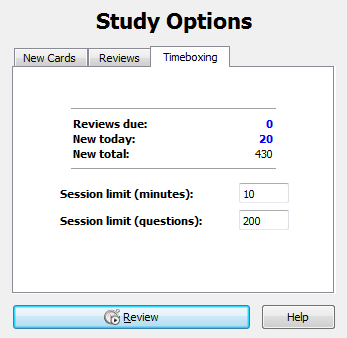
The flashcards, as flashcards often do, capitalize on repetition. But this repetition is smart and effective repetition. As you go through the cards, the program brings back cards that you’ve forgotten more frequently than cards you’ve remembered. It also takes into account how long it takes you to click Show Answer.
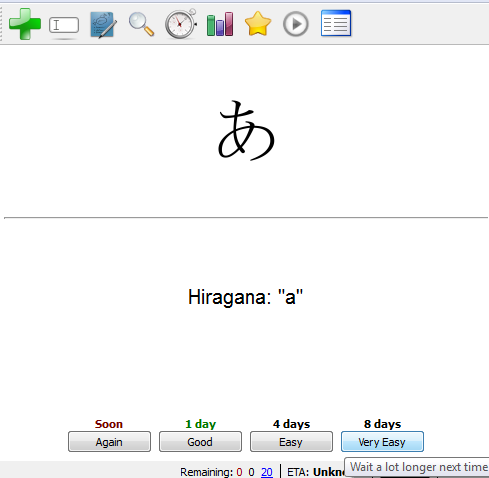
The conclusion: Anki is a great flashcard program. It’s free. It’s smart. It uses your time effectively because it doesn’t waste time reviewing information that you already know, and focuses instead on what you struggle with. While I dislike making my own decks and how boring the interface itself looks, this is a great language-learning resource. There are tons of free, pre-made decks of Korean vocabulary, grammar, Hangul, practice sentences, hanja, etc. as well as lots of other stuff that might interest you. And if you don’t like it after downloading and trying it, then just delete it from your computer!
An extra muffin: Anki is a free program, but it has to support itself somehow. Proceeds from its Anki app and donations from users help it stay free. If you really like Anki on your computer, consider paying the creators back and getting yourself the Anki app.
감사합니다!

Lyrics created in Photoshop 11. Please credit if you remove for your own purposes.
[Seungri]
Saramdeul da tteonado moduga deungeul dollyeodo kayeoun-deuthan nae moseube neo dongjeong-haedo (Even if everyone leaves, even if everyone turns against me, Even if you take pity over my pathetic self)[Daesung]
Sesangeun andwehn-da-go nae-ge marhajiman geu nalye ul-ko it-deon nan chigeum utko isseo (The world tells me that I can’t but The crying me of the past is now smiling)[Taeyang]
Eonjena boran -deushi kkeut-kkaji churakhajiman I’m alive (I’m falling down till the end as if it’s for show but I’m alive)
Nan teo isang irheul-ke eop-seo kwahkeoneun dwiiroha-go jump out (There’s nothing more to lose now, I’m gonna push the past behind and jump out)
Gipi tteo-reojigo i-nneun nae moseubi areumdawo chigeum (The image of me falling deep is so beautiful)Nae jashineul haneu-re deonjyeo nan jayurowo, I sunkan-mankeumeun nan sara-isseo I’m still alive (I’m even more alive at this moment, I’m still alive)

Lyrics created in Photoshop 11. Please credit if you remove for your own purposes.
One of my favorite lyric-Photoshop creations ^_^
Fantastic baby live version of Fantastic Baby from their Alive World Tour: http://www.youtube.com/watch?v=siVPAd0O5KQ

Lyrics created in Photoshop 11. Please credit if you remove for your own purposes.
sumanheun saramdeul tteonagadoi noraen yeongwonhae ne gyeote (hamkke halgeoya)
Even though many people will leave you, this song will stay with you forever (well do it together)
geu manteon chingudeul da tteonadoyeogi nan ne yeope gyesok seo isseulgeoya
Even if many friends all leave you, I’ll continue to stand here by your side
Baby don’t cry baby don’t cry baby don’t cry
eonjenga deo bitnalgeoya Give me your smile
Someday you will surely shine; just give me your smile
Baby don’t cry baby don’t cry baby don’t cry
hanbeonman deo nal wihae Just give me your smile
One more time for me, just give me your smile
Translation credit to: http://www.youtube.com/watch?v=ltahc2BCS4s
안녕하세요! Are you still struggling to read Korean? Maybe you mix up certain vowels all the time, or you just cannot seem to ever pronounce a specific letter correctly. While I still think that practicing writing out words, phrases, even lyrics to entire songs in Korean can really help you master Hangul, it’s always nice to have a quick and easy reference to check when you’re struggling. My best friend sent me this post from Pinterest; it explains how to read Hangul through a comic-style format by associating the different symbols with words and objects that use the same pronunciation. I definitely recommend this Pinterest post whether you’re just beginning to learn Korean or if you’re a seasoned champ who reads a chapter book written in Hangul a day.
Check it out here if you still haven’t clicked: http://pinterest.com/pin/227642956135413610/
감사합니다!
 서울드림
서울드림 