Mistakes in Korean: And with one word, I changed my gender

missInterpretation header made in Photoshop 11 by myseouldream.com creator

안녕하세요!

If you know a little bit about Korean culture and how Koreans generally refer to each other with titles based on their relationship and gender, you’ll probably be very disappointed in this failure of mine. It’s a mistake on something so elementary (and you know I just wanted to use that word instead of basic—makes me feel like Sherlock Holmes—don’t judge me) that I cringe every time I remember reading the comment on my italki post.

A while ago, I wrote an italki post about how my sister and her husband just bought their first house. I was extremely excited as I began to type.

“오늘은 우리…”

And with the third word, I already made a mistake and essentially changed my gender.

“…누나이랑매형”

오, 오, 오오오오오~!!!! 이거 봐?!


Nuna? Nuna?

What is nuna, you ask. Allow me to explain. Nuna is the name given to a close older sister or female friend of a guy.

Just so you know, my friend, I am female. In Korean, I should call my older sister eonni. 언니.

Perhaps you don’t think this isn’t that bad of a mistake but I was extremely embarrassed.

(Not to mention I used the wrong version of irang/rang to link my sister and my brother-in-laws titles, and his title was also wrong because it should’ve been 형부 for a girl calling her brother-in-law. But you don’t need to know that I did that. It’s just my personal insult to injury. Oh thanks, brain. You da best.)

Have you made any mistakes while language learning?

감사합니다!

Naver Dictionary (the greatest thing since sliced bread)

안녕하세요!

Have you been using Google Translate to figure out if you said something correctly? Or have you been getting lazy and just typing out everything in English, checking it a couple times by translating it back and forth with Google, and then sending off a message to your language partner? Bad idea. Not an awful idea, because Google Translate is definitely helpful. But it’s also dangerous, because it throws a word back at you and you really don’t know if that word means what it’s supposed to mean in the context that you put it in. I’m speaking from experience.

Princess Bride (awesome classic - go watch it now! 지금!

My poor language partner must always feel like this when he reads my Kakaotalk message

Naver’s online dictionary is awesome. Yes, go ahead and use Google Translate to check things if you must (guilty, I use it sometimes, too) but don’t get dependent on it. There are lots of other online resources that work much, much better. Naver Dictionary is a prime example.

I love Naver Dictionary, henceforth titled as Endic (English Dictionary, which is the version I use because hey, English is my native language…although you wouldn’t think it if you actually heard me trying to talk coherently in real life – learning Japanese, Korean, and Spanish has severely messed with my ability to do the words flowing nicely together thing) for many reasons. Here are some of them.

  • You can type in either a Korean or English word and get tons of results
  • Words/meanings? Synonyms? Antonyms? Idioms? All of these pop up when you type in just a single word
  • Contextual examples. That’s right. They have specific references to actual news sources on the web or elsewhere with the context of the word explained, highlighted, with neon signs blinking around it and a giant Pororo dancing on top of it (well no but you get the idea)
  • Many of the results have audio – go ahead and listen to what you’re reading
  • Teaching yourself Korean and have hardly any vocabulary to flaunt? You can view Korean word lists for 7th through 12th graders by clicking on them on the right side bar or by searching specifically a grade’s curriculum
  • Search by importance of words, by a specific subject/field (ie philosophy, literature, history, religion…)
  • After you search, it usually comes up with similar words that you might want to check out
  • You can make a Naver account and save words that you look up automatically to as many different vocabulary lists as you want
  • You can also view a history of the words you’ve looked up in case you tend to forget the word you just learned (now that’s annoying)

Endic is pretty fantastic. But it is a little tricky to navigate at first, so give it some time. You’ll love it once you do.

감사합니다!

Fail – when mistakes in Korean “bring tears to your eyes”

missInterpretation header made in Photoshop 11 by myseouldream.com creator

안녕하세요!

Everybody makes mistakes. The point is that you’re supposed to learn from your mistakes. I’ve decided to start posting about mistakes that I make on my journey of learning Korean (and I’m learning Japanese, too!) in order to help myself not make them again – and to help others not make them in the first place. Continue reading

The Plural Form in Korean

안녕하세요!

Dogs. Cats. People. Students. Eyes. What do these words have in common? They’re in the plural form. That’s right, 2+ of everything. But what about these?

개. 고양이. 사람. 학생.

You could read that as “Dog, Cat, Person, Student” – or you could interpret it as “Dogs, Cats, People, Students” depending on the context that I put it in.

In Korean, the official plural form comes as the addition of “-들” to a word, but it’s not used that frequently in everyday conversation. Can you still use it to clarify what you mean? Yes. Can you use it even if you don’t need to clarify because the context makes it already obvious? Yes. It’s not wrong to use “-들,” it’s just not as common as throwing in 사람 and meaning people, or 개 and meaning dogs. (Counter words and numbers help clarify the plural as well.) Continue reading

Webcomics: easy reading in simple Korean

안녕하세요!

A while ago, I stumbled across a neat little webcomic site created by another Korean language learner. Korean Comics is composed of several short scenes with a couple characters. All of the Korean used is very simple and easy to follow (I read this comic when I’d only been studying Korean for a couple months and understood most of it); however, for words or phrases that you’re unfamiliar with, the creator added notes. You can check out the vocabulary for each scene on a separate page, read the entire web comic with English notes beneath each picture, or read it all without any English notes at all to challenge yourself. Continue reading

linguanaut – language learning survival tips

안녕하세요!

One of my favorite quick-reference sites is linguanaut. It has over 50 languages available, but I use it for Korean and Japanese. (Depending on the language you’re looking for, it has even more than just what the Korean section includes. For example, the Japanese references include a category just for famous Japanese sayings, which is pretty neat!) Its Korean section includes: Continue reading

Dongsa – Korean Verb Conjugating App Review

안녕하세요!

Dongsa

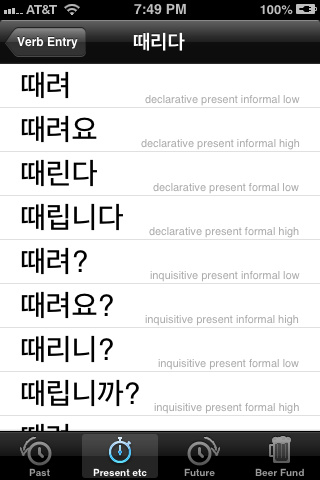
I recently discovered a fantastic app that does one thing, and that one thing very well. It conjugates Korean verbs. Dongsa, the free app that makes the features of dongsa.net more accessible to smartphone users, is exactly what you need to download (also available for Android, not just Apple) or visit right now.

Maybe conjugation isn’t a big deal to you, but conjugating can get confusing very quickly, especially when you’re just starting out as a Korean-language learner. It feels like there are way too many different politeness levels – all with their own variation on conjugation. Dongsa provides for this.

Dongsa screenshot

Type in the verb.

Wondering how to conjugate the verb for “to hit”? Go ahead and open Dongsa.

Notice that the app includes helpful notes for each conjugation – declarative? Inquisitive? Formal level is low? Dongsa will let you know.

Dongsa screenshot


There isn’t much to say about Dongsa other than that it’s super useful, free (you can donate to the developers’ beer fund if you feel really happy about how helpful Dongsa is), and simple to use.

These guys made this for you. Can you sacrifice an iTunes song for their cause?

Interesting concept for paying them back…


Dongsa screenshot

It comes in different tenses, how sublime!


This app is definitely a great tool to have on hand when you can’t remember how on earth you conjugate 공부하다 in the inquisitive past informal low – although that has to be one of the easiest ones to conjugate. You really do need this app, then…


감사합니다!


italki Review

italki screenshot (not mine)

안녕하세요!

Have you been looking for a way to practice your target language? Whatever the language might be (with the exception of some really far-out, ten-people-in-the-world-speak-it languages), you can probably find a native speaker on italki. italki is a site dedicated to connecting you to the people you need. Continue reading

Confucius Lives Next Door

안녕하세요!


confucius


While you may tell yourself that you’re only interested in South Korea, Confucius Lives Next Door by T. R. Reid is my number one book for learning about Asian (not just South Korean) culture. Maybe there’s a better book out there that I haven’t read yet, but this book really takes the cake. Or the kimchi.


Kimchi. Yum.

Kimchi. Yum. Awful attempt at making an image of kimchi spell the word kimchi. Not yum. My apologies…


Confucius Lives Next Door: What Living in the East Teaches Us About Living in the West is primarily written about the author’s experience with the culture in Japan; however, as the author spent time living in places throughout Asia, including South Korea, I find this relatively inconsequential, because there’s a lot to be learned about Asian culture in general from this book. The book is a goldmine of information about the reasons why Asian culture is the way it is -and how America can benefit from it.

So who’s the incredibly wise guy whose social, economic, and cultural influence is still going strong throughout China, Japan, South Korea, etc.?


Confucius - The Greatest Thinker and Educator

This guy. Confucius – The Greatest Thinker and Educator


T. R. Reid knows quite a lot about Confucius, yet the book doesn’t talk about Confucius’ life. The book details Reid’s experience and afterthoughts on moving with his family to Asia. It explains how Confucianism is pervasive to Asian culture and how it has helped create not only the incredible “Economic Miracle” of rapidly modernizing and prospering Asian countries but also the lesser known but equally important “Social Miracle.” It even explores comparisons between Asia and the United States, and, though the book is more than a decade old, it remains useful to the reader seeking cultural understanding.

Pick up a copy of Confucius Lives Next Door and start understanding why family is so important in South Korea, why honorifics, formal language, bowing, deferral to elders, and general social stability are a common element to much of Asia. Yeah, yeah, Confucius is part of the reason. But the other reasons are discussed in the pages of T.R. Reid’s book. Read it. You won’t regret it.

And if you’re afraid it’ll be boring, Reid’s humorous yet cuttingly informative writing style will keep you interested to the very end.


Read some goodreads opinions.

Read another person’s review of T.R. Reid’s book (it’s not just me!).

Find out more about T.R. Reid on the man’s own site.

confucius 2

감사합니다!

Stroke Order: Hangul’s tribute to Chinese Calligraphy

'Stroke' text created in Photoshop 11

안녕하세요~!

Just like Chinese characters have a specific order to their lines, hangul letters also have proper stroke order. While no one’s going to give you a dakbam (probably) if you draw the bottom line before the top, it’s a good idea to learn stroke order. If you’re going to learn how to do something, why not learn how to do it correctly?

Although at first it’ll be difficult to remember the proper order, and writing with stroke order will slow you down, it’s worth it. Once you get the hang of it, those hangul letters will all but fly off the tip of your pen. It just takes a little practice.

Check out this site which provides images of each step to drawing the correct order for each hangul letter. This other site includes playable clips of writing in hangul with correct stroke order.

감사합니다!

Reference Links:

http://www.speakoutkorean.com/learn-to-write-korean-stroke-order-consonants/

http://www.sayjack.com/blog/2010/12/17/stroke-order-of-korean-hangul/