Who is Pororo?

Pororo and Friends courtesy of http://ayiekpunya.wordpress.com/pororo-wallpaper/

안녕하세요!

If you’re interested in Korean culture – and I mean modern culture – or you watch dramas or variety shows, you’ve probably heard of Pororo. Pororo is a famous little blue penguin who is the protagonist of his own show – Pororo the Little Penguin.

While you might dismiss Pororo as an uninteresting children-oriented character, think again. Pororo is famous in South Korea; he is one of the most-watched kids’ shows, and just about everybody knows what you’re talking about when you reference him. From a language-learner’s perspective, Pororo is gold.

dancing Pororo GIF from Viki

He’s a happy dancer, too.

Many non-native English speakers who come to the U.S. watch Sesame Street and learn the fundamentals, or supplement what they already know. Pororo is similar to Sesame Street in that sense. It’s broadcasted on EBS in South Korea and each episode is about 5 minutes long. 5 minutes. And you can watch its 73 episodes on Viki for free, subtitled in English and Spanish, and sometimes even in Turkish and other languages. (Viki also has an app, so you can watch shows on the go!)

No matter what age you are, kids’ shows can be enjoyable. They’re a nice, stress-free break from the rest of reality. But as a language-learner, no offense but your comprehension skills aren’t what they are for your age in English unless you’re perfectly fluent. They’re probably notched down quite a bit – perhaps more to a pre-schooler or middle-schooler. Pororo the Little Penguin is the perfect fit.

Not only will Pororo help you learn Korean, but it will also provide a conversation point when you go to South Korea. “Oh, you watch Pororo?!” Of course, not every person you meet will want to discuss the plot of episode 34, but it’s a starting point, and maybe it’ll make your conversation partner think, “Wow, this person is serious about learning my language.” And it’s always nice to make a good impression.

Pororo and friends courtesy of http://themepack-gratis.blogspot.com/2011/10/pororo-little-penguin-wallpapers.html

감사합니다!

Korean Greetings & Farewells

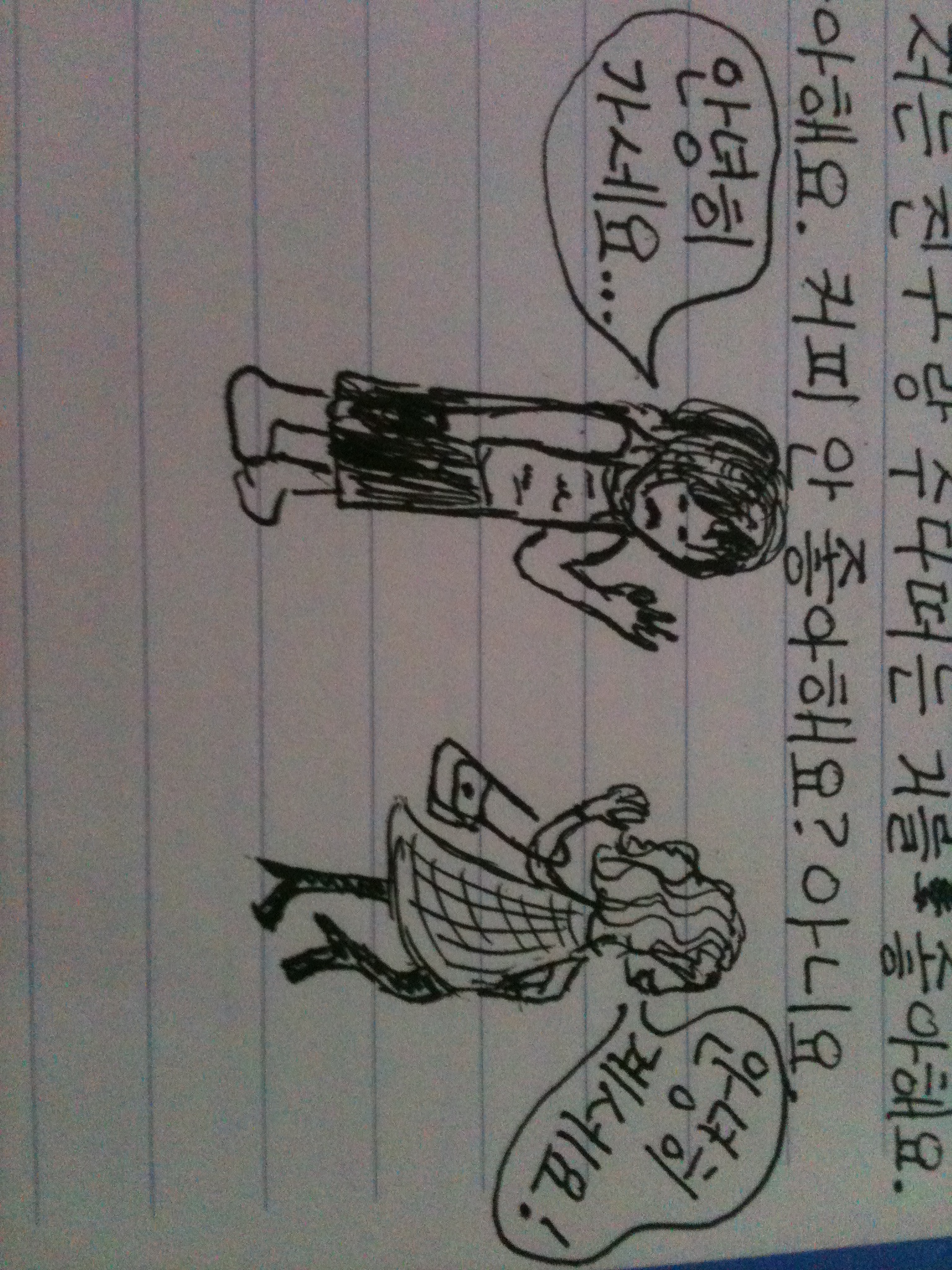
I have the best drawing skills, you know.

Goodbye vs. Goodbye in Korean

안녕하세요!

Greetings and farewells in Korean are quite interesting thanks to the common root of “annyeong” or 안녕. Because 안녕 literally means peace, when it combines with -haseyo, it means “Are you at peace?” While informal greetings and goodbyes usually consist of quick “안녕~”s without -haseyo’s and -hi-gaseyo’s and -hi-gyeseyo’s, it’s a must to learn the difference between them.


안녕 + 하세요 = peace + you do/please do


안녕하세요 (annyeonghaseyo) is usually translated as “Hello”  or just “Hi” but it is informal and 안녕 alone might be more suited for meaning an informal “Hi”. And if you’ve watched any k-dramas or know anything about Korean culture, you’ll know that bows often accompany greetings. Bow and say annyeonghaseyo! It’s all about respect. Be respectful and you’ll be respected.


안녕 + 히 가세요 = peace + you go


안녕히 가세요 (annyeonghi-gaseyo) is what you say when you are staying and the other person is leaving. In Korean, the verb for “to go” is 다 (kada). Thus, “go” is 가 (ka). Look at this goodbye again: 아녕히 세요. Can you guess what it means? Go in peace. Annyeong-hi-gaseyo.


안녕 + 히 계세요 = peace + you stay


안녕히 계세요 (annyeonghi-gyeseyo) is what you say when you are leaving and the other person is staying. What does it mean? Stay in peace.


알았어요? Just remember. Ka/ga for go. Annyeonghi-GAseyo. 안녕히 가세요. But do you remember “hello”? What are the two formal farewells? Let’s use a story to put things into perspective.


안녕세요. Annyeonghaseyo – because you were walking through a huge grocery store looking determinedly for brussel sprouts so that you could burn them to release stress, and when you found them you shouted, “HA! 안녕세요. AnnyeongHAseyo, you little sprouts!” Then you saw me running in the opposite direction because I was unnerved by the weird actions of a person speaking Korean to vegetables. What did you say to me? 안녕히 세요! “Annyeonghi-GAseyo!” You said, because I was going (ka/ga = go) and you were staying. “안녕히 세요! Annyeonghi-GYEseyo!” I shouted back to you over my shoulder, hoping desperately that you would STAY and not follow me home to burn brussel sprouts in my front yard.


Please check out Talk To Me In Korean’s lessons on the 3 annyeong’s:

Level 1 Lesson 1: Hello & Thank-you

Level 1 Lesson 3: Goodbye, See you

And for a bit more learning, look at Greetings in Korean, courtesy of Rocket Languages.


Note: Informal Korean doesn’t necessarily use 안녕 all the time for greetings and farewells. While an always safe and natural fallback, 안녕 is just the tip of the ice berg. Do you always tell your friends “Bye” when you’re leaving and “Hello” when you’re arriving? No. You say things like “What’s up”, “Catcha later,” “Hey,” “See ya,” “Hallooooo~” and any other variation. Once you get the 3 annyeong’s down, learn some other ways of greeting and goodbye-ing – it’ll be great for your vocabulary and make you sound more natural when speaking informally with friends.

감사합니다!

Confucius

When you have faults, do not fear to abandon them.

-Confucius

허물이 있다면, 버리기를 두려워말라.

-공자

Translation courtesy of Hwangssabu-nim.

Miguel Hidalgo

Action must be taken at once! There is no time to be lost.

-Miguel Hidalgo


행동은 즉시 취해져야 한다. 허비할 시간이 없기 때문이다.

– 미구엘 히달고


Courtesy of Hwangssabu on Twitter.

Stupid Liar – BIGBANG

Stupid Liar - BIGBANG

Stupid Liar text created in Photoshop 11. Please credit if you remove for your own use.

Starting Smart & Small: Reading in Korean

안녕하세요!

I recently discovered a wonderful and unexpected resource – the library. While yes, the avid language learner can go search out grammar guides and Korean-English dictionaries, and maybe find a set of old CDs that teach tourist-level phrases, there’s something much, much better hiding in your library.

Children’s books.

That’s right. Cute picture books with simple sentences, simple grammar, simple vocabulary. While there are also lots of chapter books available in non-English languages, children’s books are 대박. Grab those first, and don’t even think about eyeing those bigger books even though you really want to feel accomplished with your level of Korean.

Why? 왜요?

Think about how you naturally learn a language as a child. You learned your native tongue from adults speaking it around you constantly. You might have watched TV shows that solidified what you heard from adults, as well as introduced you to a larger world than your house, backyard, and preschool. But one of the other ways you learned was by reading with an adult. Children who read a lot from a young age tend to have more natural writing skills. If you want to learn to write well in Korean, start small, and start with reading. Even if you think your Korean is relatively advanced, don’t just head straight for the chapter books. If they’re too hard, they might discourage you and you’ll feel frustrated. Don’t give up!

Children’s books still provide a fair challenge – and as a bonus, depending on the book, they introduce you to stories that native Koreans grew up with and still remember fondly. I discovered that my Korean friend and I read the same book as children – yet she read in Korean and I, English. She had me read the Korean book aloud to her and translate it. While I still struggled with some meanings, it was encouraging and I finished the book with a stronger understanding of general sentence structure and a few words added to my vocabulary. Not to mention, I fixed some pronunciation with my friend’s help!

The next time you’re wandering through shelves looking for a good read, head for the foreign titles section, browse through the Korean selection, and choose the easiest-looking picture book you can find. To make more enjoyable, choose one that you read in English as a child – it’ll be more meaningful and since you’ll remember the general story, understanding the Korean will come easily.

Start smart. Start small. And soon you’ll be reading in Korean like, well, a five-year old.

But still, a five-year old Korean reads much better than an English-speaker who can’t even tell which Asian language is written on the cover of a kid’s picture book. Think of it as your first step, your first book as a child that you tried to read by yourself; if you pursue it and practice, your Korean will “grow up” into those big chapter books and open a whole new world. Just like your first language did.

Gandhi

If I have the belief that I can do it, I shall surely acquire the capacity to do it even if I may not have the capacity at the beginning.-Mahatma Gandhi

할 수 있다는 믿음을 가지면 처음에는 그런 능력이 없을지라도 결국에는 할 수 있는 능력을 확실히 갖게 된다. – 모한다스 카람찬드 간디

Courtesy of Hwangssabu on Twitter.

Slang Expressions in Korean (Talk To Me In Korean) Review

안녕하세요!

I can say without a doubt that Talk To Me In Korean is my favorite Korean study resource. It has constant updates to add to its existing lessons and it uses really fun and informative videos, audio, PDFs, physical textbooks, pictures, and more (ie social media like Twitter and Facebook) to teach Korean. Since I love TTMIK, I was excited to try their Slang Expressions in Korean lessons (they’re available online at My Korean Store). This great product allows the purchaser to choose which price to pay based on their funds or what they personally think the product is worth and is inexpensively priced at $2.99, $4.99 or $9.99.

The Slang Expressions lessons are well worth any price. The package comes as an online download; after purchasing, I waited a few minutes for a confirmation email and then an email with a link to a temporary download. The lesson package can be downloaded a couple times (if you have multiple computers, you can download it to each one rather than spending time transferring with a USB), and the download link expires after about a week (so if you decide to get this, don’t sit around for a month not checking your email and wondering where on earth your Korean slang lessons have gone).

The Slang Expressions download came as a zipped folder that unzipped to show four audio files (I copied them to iTunes and added them to my ‘TTMIK Extras’ playlist) and a PDF (if you have an iPhone, download the iBooks app for free, add the PDF to your iTunes books library by dragging it or copying it, then sync that PDF to your phone to study Korean on the go). The four audio files included three lessons – Chapters 1, 2, and 3 – and a great Mini Dialogue Audio Track to practice with at the end of the lessons.

iBooks PDFs

The audio

  • each lesson is 16-17 minutes
  • the mini dialogue is about 8 minutes
  • each lesson corresponds to a chapter in the PDF and includes 10 slang expressions
  • a slang expression is given, its meaning is explained, and different forms (ie noun, adjective, adverb, etc.) are also given
  • the origin of the slang expression is also explained
  • mini conversations between native Korean speakers (mainly in 반말 or informal language because this is slang Korean) help clarify usage at the end of the explanation: the first speaker talks, 선현우선생님 translates, the second speaker talks, 선현우선생님 translates, etc. until the conversations ends; then the conversation is repeated but without translation in between speakers
  • though the PDF is a great tool for reading Korean and reinforcing the slang expressions, the audio allows you to multitask by listening to the slang lessons while you’re busy folding laundry, working out, or getting from A to B

The PDF

  • the PDF is efficiently organized into three chapters that correspond to the audio
  • everything spoken in the audio is included in the PDF
  • Korean words and dialogues are written in hangul without romanization pronunciation guides, so it’s best to listen to the audio alongside reading the PDF (at least for the first time)
  • dialogues and examples of the word in other usages are on the left side; translations are on the right (the following picture is zoomed in on the examples and dialogue)

Slang Expressions screenshotOverall…

One big reason why I love TTMIK is that their lessons, while being extremely relevant, helpful, and informative, are never boring, and just about every sample dialogue is funny (I often find myself laughing while I’m studying). Each useful phrase is either a common real-life example or a conversation that sounds like it’s straight out of a funny and romantic Korean drama. These Slang Expressions in Korean lessons include some of my favorite funny dialogues.

Slang Expressions dialogue

Beyond being funny and memorable, the phrases are surprisingly relevant. I hesitated to buy this at first because the phrases that the product description mentioned seemed irrelevant to most regular conversations – yet the lessons’ examples showed me that these phrases are a great asset to my vocabulary; I can’t wait to begin using them naturally in conversations and understanding their use in music, shows, and real life.

I definitely recommend that you check out the sample audio and PDF and then purchase these lessons to add to your Korean study resources. If your Korean isn’t high enough to understand complex grammar and all the ins and outs of how a sentence is put together, don’t worry; these lessons are very simple and easy to follow, and you can always begin by memorizing terms. Save the sentence dissection for when you get to that level. Speaking a language is all about sounding natural, and these Slang Expressions can set you on the right path.

NOTE: The majority of the Slang Expressions lessons are in informal language or 반말, which means just because you’re feeling high and mighty and like a G-Dragon perty boy (Crayon? Anyone, anyone?) you can’t just casually use slang to an older person or someone you’re supposed to be polite to. If you’re not sure, don’t use it – in case it’ll offend the other person. You might seem more rude and stupid than fluent and intelligent.

감사합니다!

Eleanor Roosevelt

자신이 할 수 없을 거라고 생각하는 일들을 해야만 한다.

You must do the things you think you cannot do.

– Eleanor Roosevelt

Eleanor Roosevelt was 대박. Quote and translation courtesy of Wise Saying on Twitter.

Abraham Lincoln

무엇을 하든 훌륭한 사람이 되라.

Whatever you are, be a good one.

– Abraham Lincoln

Quote courtesy of Wise Saying on Twitter.