I don’t usually write blog posts about food, but the yogurt soju and the nurungji soup at take 31 in New York City was so delicious that I can’t help it. take 31 isn’t in Korea Town, but it has a distinctive vibe that brings to mind backstreet bars in Hongdae and cozy restaurants in Hapjeong. Everything from the brick walls to the playlist of mostly K-indie and underground/older hip-hop gives it that perfect late-night on the backstreets of Hongdae feel.
Flavored soju, special makgeolli (Korean rice wine), and a wide selection of other types of alcohol at this 술집 isn’t the only thing that sets it apart. take 31 is literally set apart from Korea Town because it is tucked away on a narrow street a good ten or so minutes away. Amid a chill, youthful atmosphere, it serves a remarkably diverse menu of Korean food, ranging from typical Korean fare like seafood pancakes and pig feet to the amazing nurungji soup that my boyfriend and I ordered.
I had never even heard of 누룽지탕 before and didn’t understand why he started laughing at the menu.
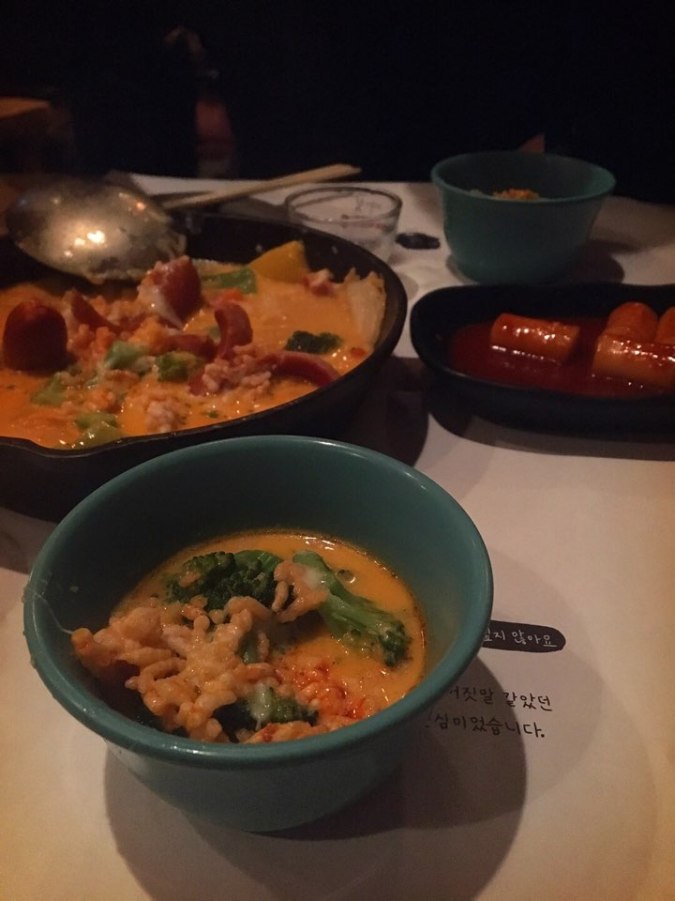
“누룽지맨하탕?” He laughed before explaining that it was a pun that put Manhattan into the soup’s original Korean name, remaking it into Manhattan-style nurungji soup. The English menu describes it as creamy kimchi stew with crunchy rice, sausages, bacon, broccoli, paprika, and onions. Worried about trying food with a kick? This was barely spicy and felt like a comforting hug that went straight to my belly. Yum.
A typical Korean 요구르트 drink
We also tried the yogurt soju, which was incredibly refreshing and tasty. The name doesn’t mean yogurt in the general American sense. Have you ever had one of those cute little yogurt drinks from a Korean store? Think of that + iced soju. Again, yum.
Feeling hungry for some 한식 and 소주 yet? Check out the menu in both Korean and English here. This place is slightly pricey, but definitely worth it.
Looking for shows about foreigners in Korea? Trying to improve your Korean by watching fun shows? Look no further. Here are two shows I highly recommend!
Talk show/debate format mimicking a UN-style summit
Features non-Koreans who are conversational or fluent in Korean
Each member represents a different country
The summit is headed by three Korean MCs
Korean celebrities appear as guests that present a weekly topic, usually social/cultural/personal issues of their own or that are submitted to the show
Members vote if the agenda is normal/abnormal and then debate
English subtitles easily available
Very popular in Korea
Many of the original summit members have become foreign celebrities in Korea with CFs and their own businesses
If you like watching non-drama shows and are a foreigner, chances are you’ve already heard of this. Abnormal Summit gathers Korean-speaking male foreigners from various countries who are living and working in Korea and engages them in dialogue over cultural differences. Generally, a celebrity guest appears on the show and represents the person who submitted the issue, or they sometimes bring their own problems. The members vote on whether the person is “normal” or “abnormal” and then debate from their respective cultural perspectives.
Naturally, having a single person represent the perspective of, say, all of the United States, or Malaysia, or the UK (shall I go on?), is an enormous simplification. But the show’s concept is fascinating and it is immensely fun to practice Korean by listening to a group of foreigners and three Korean MCs discuss cultural differences and their personal experiences. The foreign members are non-Koreans who are fluent or conversational in Korean. Their pronunciation isn’t always great, and when they make a mistake, all the agony of language-learning suddenly is validated. I’m not the only one who makes mistakes!
Sorry for reveling in the mistakes of others for a moment, but it’s always nice to know you’re not the only one. And if these guys can go on Korean TV and debate difficult cultural conflicts without being fully fluent in Korean, why not you? Why not me? Let’s learn all the Korean! This show has English subtitles available on different sites, so never fear.
This show is comedic much of the time, but also can offer truly intense and in-depth debates and insights on current global issues or national issues, so you won’t just be practicing Korean but also learning about current events.
And yes – only men get to be permanent guests on Abnormal Summit. There was another show, 미녀들의 수다 or “Beautiful Women”, that featured foreign women, but it ended in controversy.
미수다 was known by various names like “A Chat with Beauties” or “Global Talk Show” and was fairly popular until its ratings crashed and burned in 2009 when a panelist said that men under 180 cm were losers and she would never date them. Ah, is that so? Great, thanks for ruining the one show featuring foreign women. There was controversy over whether she was forced to say this per a script or if it truly was her opinion, but regardless of the real culprit, the show stopped airing after that.
미녀들의 수다 Talk Show Poster
But still, can we get a show in this intercultural debate format that features foreigners who speak Korean – but not limit it to only men or only women?
Each episode or set of episodes focuses on a different mixed couple
All episodes available for free on the EBS website
Korean subs available but no English subs
Not as popular as 비정상회잠
Commentator’s 아저씨 voice is fantastic
Global Family is a documentary-style show from EBS that goes into the homes and lives of international couples living in Korea – where one of the couples is native Korean. The other may be from any number of countries ranging from Canada to Ukraine, and the non-Koreans vary in their Korean ability and their years living in Korea. Some are married, some engaged. All the episodes that I have seen address the relationship between the foreign-in-law and their Korean in-laws in a way that challenges the stereotype of fierce in-laws and prejudice against foreign wives or husbands.
This show is a great way to see the interaction between different cultures in terms of relationships and establishing a family in Korea. For me, it also has become a source of encouragement like Abnormal Summit because while some foreigners are fluent in Korean, others stumble in their pronunciation and make hilarious mistakes on camera – but does that stop them? No!
Nor should you or I stop. We will make mistakes. We will laugh at our mistakes. Learn from them. And move on and make new mistakes but not make the same mistake twice. That’s what shows about foreigners in Korea can teach you. Not just cultural differences and intercultural communication, but being fearless in your efforts to use Korean.
Unfortunately, I don’t know of a site that has this show subtitled in English. The EBS site does offer Korean subtitles, which can help you catch words you don’t hear correctly, and improve your reading along with your listening, but it presents a challenge for Korean-learners who aren’t ready yet for subtitle-less shows. Start with Abnormal Summit, and try out Global Family when you’re ready for more of a challenge!
If you like other shows that feature foreigners speaking Korean, or know of English subs for Global Family, let me know in the comment section below.
Jk, lmao, lol, omg. English has tons of text talk, and so does Korean. If you’ve been chatting with native Korean speakers via Hellotalk, Italki, or KakaoTalk (if you want to find a language partner, read this post), you may have seen many abbreviations already – but do you know what they mean? Over time, you’ll start to accumulate more and more text-talk acronyms in Korean, but here’s a quick and easy list to get you started on the basics!
ㅇㅋ오케이 – Okay
ㅇㅇ응/웅 – Yeah, uh-huh (응 is informal whereas 네 and 예 are formal)
ㄴㄴ노노 – “No” doubled for extra effect. Using just one ‘no’? That’s ㄴㄴ!
ㄳㄳ감사감사/감사합니다 – Thanks
ㅈㅅ죄송/죄송합니다 – Sorry
ㅇㅈ인정 – Acknowledged (This can be like saying “Yeah, agreed”)
ㅂㅂ바이바이 – Bye-bye
ㄷㄷㄷ덜덜 떨다 – Verb phrase for “to tremble all over”. Use when shaking from amazement, fear, the frigid wintry winds…
ㅋㅋ크크/쿡쿡 – Keke (basic text-talk for laughter)
ㅎㅎ흐흐/하하 – Hehe/haha (basic text-talk for laughter)
ㅇㄱㄹㅇ이거 레알 – “This is real.” While it originated as a twist on the Korean spelling of “real” as 리얼, Real Madrid fans took this 신조어 further and now many Koreans use this in place of a sentence like “이거 진짜야!” ㅇㄱㄹㅇ. Don’t believe me?
“사용 권장 하는 말은 아니지만요…” Not sure why a show host cautioned usage. If you know why, please leave a comment so I can update this list!
If you’d like to see more list posts, let me know. 오늘도 방문해 주셔서 감사합니다!
As one of my majors is Korean Studies and I am currently working on a thesis that utilizes literature about or from the critical period of democracy and labor movements in the 1960s through 80s (send help), I have had my fair share of struggling to find source materials.
When you’re not in Korea, it can be difficult to get your hands on a copy of a Korean-language book, let alone one in translation. Hard copy? Ebook? At this point, it doesn’t matter what format it takes, as long as it’s readable. Here are my methods for securing that hard-to-find copy of a Korean book I desperately want (or in the case of my thesis, need) to read. Continue reading →
Incredibly enough, it has now been over a year since I joined the translation team for Humans of Seoul, a Facebook page (as well as tumblr and Instagram) that introduces the lives and thoughts of humans from Seoul in both Korean and English. Inspired by the famous Humans of New York page, our page has also built its own claim to fame in its provision of bilingual interviews and its side pages for learning Korean and English.
As these interviews are for humans, by humans, and introduce thoughts from humans, a natural amount of human error results in the process of taking an idea from the words of a person halfway around the world and then translating it in a way that an English-speaker will understand. Translation isn’t just about plugging in one word at a time and assembling an identical line of words. That’s what most automatic translators do.
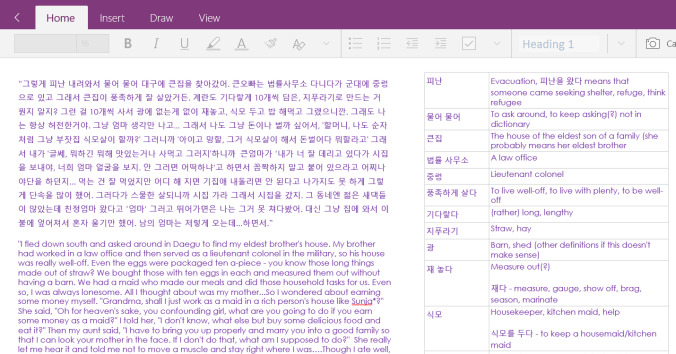
After a year at this work, I’ve developed my own style for translating. First, I read through the entire interview, and pick out any words that I feel remotely uncertain about. Then, yes, I do translate these one by one, basically out of context. I jot down every possible meaning I can find for that word. Then I go back to the interview and, in a stream of consciousness-like state, write what I think the person is saying. When I hit little speed bumps (the uncertain words), I glance at the list I created. Now, with context, I know which one matters and the English version comes into existence.
Sometimes a word isn’t anywhere. Naver dictionary? Doesn’t have it. Google Translate? Doesn’t have it/is unsafe. At times like this, I’ll try random variations of spelling and even Google Image it. You’d be amazed how you can figure out a word’s meaning by staring at pictures.
Like the time I couldn’t figure out what 지푸라기 꾸러미 was.
Of course, when I’m truly desperate, I ask for help from my Korean boyfriend on those sneaky, hidden words and twisted grammar structures.
And that’s how I translate. Then our team’s proofreader checks everything, makes lots of helpful comments to explain his edits, and sometimes we have a conversation over the different ways a word or sentence can be translated. Even a single word can make or break a translation.
When I first started translating, it was exhausting work. Exhilarating, but exhausting. I felt driven to make every single piece perfect before showing it to the proofreader, but with my limited Korean skills, I frequently found myself facing numerous corrections and edits. Quite the blow to my Korean-speaking ego!
All those kind 아줌마들 with their “한국어 너어어무 잘 하시네용!”s and the 할아버지들 at the Korean markets with their “아가씨가 한국 몇년 살아셨나?’s – all this faded away. Why was I translating when there was so much I didn’t know about the language, let alone culture, history, social cues – all the things that you must learn to truly, truly understand another language – even after several years of self-study and university?
Preliminary translations can be very rough. Much of this was changed before it was a finished product. Yet as difficult as they can be, I just love doing the interviews for 할머니들 and 할아버지들. There’s so much history packed into their memories.
But then, at some point, the scales started to tip back. My Korean skills grew. I cannot claim this was solely due to doggedly working at translations every week; it also came largely from talking every day with my Korean language partner-turned-boyfriend, as well as returning to Korea for two months in the summer (here‘s my reflection on three different stints studying in Korea). But translating for Humans of Seoul was indubitably instrumental.
Language skills are all about lifelong learning. They require constant maintenance and exhaustive effort. Translating is one element that has helped me, ironically, become better at translating. Am I substantially better at translating in January 2017 than I was in January 2016? I don’t know; ask my proofreader. One thing is for sure, though. My increased confidence in using Korean has opened doors that a fearful me would never have been able to open.
“Have no fear of perfection – you’ll never reach it.”
“완벽을 두려워하지 마라 – 완벽까지 할 수 없으니까.”
― Salvador Dali | 살바도르 달리
If you wait around for the day that what you do is perfect, you’ll wait forever. Do your best and keep doing better than your best – your pronunciation may be sloppy but your grammar impeccable, your grammar a bit twisted but your pronunciation near-native… Stop worrying. Just go for it. Don’t wait to speak Korean until you can speak perfectly, or you’ll never open your mouth.
Translation courtesy of yours truly. All mistakes mine.
Seouldream followers, 안녕하세요! I was invited to join my friend and fellow Humans of Seoul member’s project of translating and introducing contemporary Korean writers and poets via a web quarterly. In turn I am extending the invitation to all of you. To our knowledge, nothing of this kind currently exists, so this is a fantastic opportunity for translators, lit majors with an editor’s keen eye, and webmasters with an interest in Korean literature to get involved in an exciting new project. Please see the original ad for what qualifications are needed and how to join. I am looking forward what we accomplish together!
Since I was a high school student, I’ve tried to blog things I’m interested in. I failed to attract enough readers and quit blogging several times until December 2015, when I started this blog. In what is a little over a year, readers from 53 different countries have visited my blog, which I could never imagine when I was starting the blog. I remember desperately sharing my posts on my personal Facebook page to increase readers to little avail. It’s amazing how the readership of this blog surpassed my imagination merely after a year. Your encouragement and support played a great role in this journey, so thank you.
After modest success of the blog, I am thinking about embarking on a new project: publishing a web quarterly. Last month, I came across a literary journal called Monkey Business at a bookstore. It was a literary magazine that was dedicated to introducing contemporary…
“Darkness cannot drive out darkness; only light can do that. Hate cannot drive out hate; only love can do that.”
“어둠은 어둠을 몰아낼 수 없다. 오직 빛만이 그렇게 할 수 있다. 미움은 미움을 몰아낼 수 없다. 오직 사랑만이 그렇게 할 수 있다.”
― Martin Luther King, Jr. | 마틴 루터 킹
I had to choose from so many wonderful quotes by MLK for today’s Motivational Monday translation post, but this one has always stuck with me. And now, more than ever, it seems like everybody needs light and love in their lives. 여러분, 화이팅하세요! 여러분도 아주 잘 할 수 있다고 믿습니다~
Okay, so this is an incredibly dramatic quote for a Motivation Monday translation post, but I reread Dune over the weekend and couldn’t resist. And it isn’t that far off-base. After all, how often do we find ourselves incapable of simply getting something done or trying something new – chatting with someone in Korean at the Korean grocery store, for example – because we’re afraid? If we let ourselves stay afraid and don’t try the things that seem a bit scary, our lives will stagnate. Alright, I admit it. That was also in Dune. The clear, safe path leads downward into stagnation. I’ll stop quoting Frank Herbert now and let you get on with your Monday. 화이팅하세요!
I created a list of 25 Christmas-themed vocabulary words in honor of December 25th – it’s already less than a week away and I’m not done with all my shopping! Before I finish Christmas prep, I wanted to share some fun words and culture tips for Christmastime in Korea. But first, a tiny snow-person to brighten your day:
You may have heard that Christmas Day in Korea is a notorious couple holiday. Few people seem to celebrate unless they have small children or are Christians, so there isn’t much of an uptick in traffic, shopping, or general business. Instead, couples are everywhere, in the bars, restaurants, and walking the streets to take cute pictures in front of decorations. I’ve even heard that many people date just for the holiday season, so that they have someone to do couple things with. You can read more about the Christmas experience from this amazing blog.
What if you’re not celebrating with family and you don’t have a date for the holidays? This is where the movie Home Alone comes in. Remember Kevin’s misadventures when he’s abandoned at home for the holidays and has to fend off thieves all by himself? If you’re home alone like him, with no date to kiss under the mistletoe, you can tell your nosy coworkers and classmates that you’re spending Christmas with Kevin. I’m not making this up.
Without further ado, some simple and wintry Christmas vocab! Note that a lot of words are just the Korean pronunciation of English.
Merry Christmas 메리크리스마스
Christmas Day, Christmas Eve 크리스마스날, 크리스마스이브 (전야, 전날)
White Christmas 화이트크리스마스
Snow 눈
Snowflake 눈송이
Snowball 눈덩이
Snow fight 눈싸움
Santa Claus 산타클로스 (some children call him 산타할아버지 or Grandfather Santa as well)
Gift 선물
Snowperson 눈사람
Christmas tree 크리스마스트리
Decorations and ornaments 크리스마스의장식
Christmas lights 크리스마스등불, 전등 (전 – emphasis on them being electric Christmas lights)
Carols 크리스마스캐럴
Sledding 썰매타기, to go sledding 썰매를지치다
To go skiing 스키를타다
Snowboarding 스노보드타기
Mittens 벙어리장갑 (not gloves, which are simply 장갑)
Scarf 목도리 (to wear a scarf 목도리를하다)
Party 파티
Tinsel 장식용반짝이조각 , 금은사
A sprig of holly 호랑가시나무가지
Mistletoe 겨우살이
Couple 커플
크리스마스케빈이랑보낸다 I’m spending Christmas with Kevin (but basically I don’t have anyone to spend Christmas with so I’m home alone)
I compiled these myself so this is my disclaimer on accuracy. If it’s wrong, please let me know! And if you want more Christmas-themed Korean, try out these:






 서울드림
서울드림 